
 EN

Which Universal vs. Model-Specific Motorcycle Accessories Should Distributors Stock First?
For a distributor, choosing Motorcycle Accessories is less about building the longest catalogue and more about building an assortment that can be explained, replenished, and verified. The first decision is not whether universal items or vehicle-specific lines are “better.” It is which Motorcycle Accessories suit the evidence already available: buyer requests, channel type, fitment records, and the team’s ability to maintain clean SKU information.
A useful starting point is to treat the range as two jobs. Universal Motorcycle Accessories can create a practical base range across several rider groups. Model-Specific Moto Modification Parts can address clearer vehicle or styling requests, but they need stronger year, configuration, mounting, and packaging controls. For wholesale buyers, unclear information can create more follow-up work than a modest difference in unit cost.
Start with the job each inventory layer must do
Core Motorcycle Accessories should give a distributor coverage without forcing the warehouse to hold every possible fitment variation. Universal lines are often suitable for an initial layer when the intended use is broad and the specifications can be described without implying automatic compatibility. Examples may include items whose actual dimensions, mounting method, electrical connection, or intended location are clearly stated and can be checked before sale.
Model-specific lines have a different role. They can make sense when a distributor sees repeat requests for a defined motorcycle family or when a retail partner can reliably collect year, configuration, and installation information. In that situation, Model-Specific Moto Modification Parts are not simply more narrowly targeted Motorcycle Accessories; they are a commitment to fitment data quality.
Why universal does not mean fitment-free
The label “universal” should describe a positioning approach, not replace a specification sheet. Even Universal Motorcycle Accessories may require checks for handlebar diameter, available mounting space, voltage, connector type, clearance, load, or local installation conditions. A catalogue should state the applicable dimensions and the items that remain to be confirmed. This matters because visual similarity does not establish compatibility.
For distributors, the operational advantage of universal Motorcycle Accessories is usually simpler assortment coverage: fewer vehicle-specific listings, broader merchandising options, and a lower chance that a slow-moving model year leaves isolated stock behind. That advantage weakens if the listing lacks measurements, installation boundaries, or packaging details. In other words, a broad-fit product still needs a narrow, accurate description.
When model-specific stock deserves priority
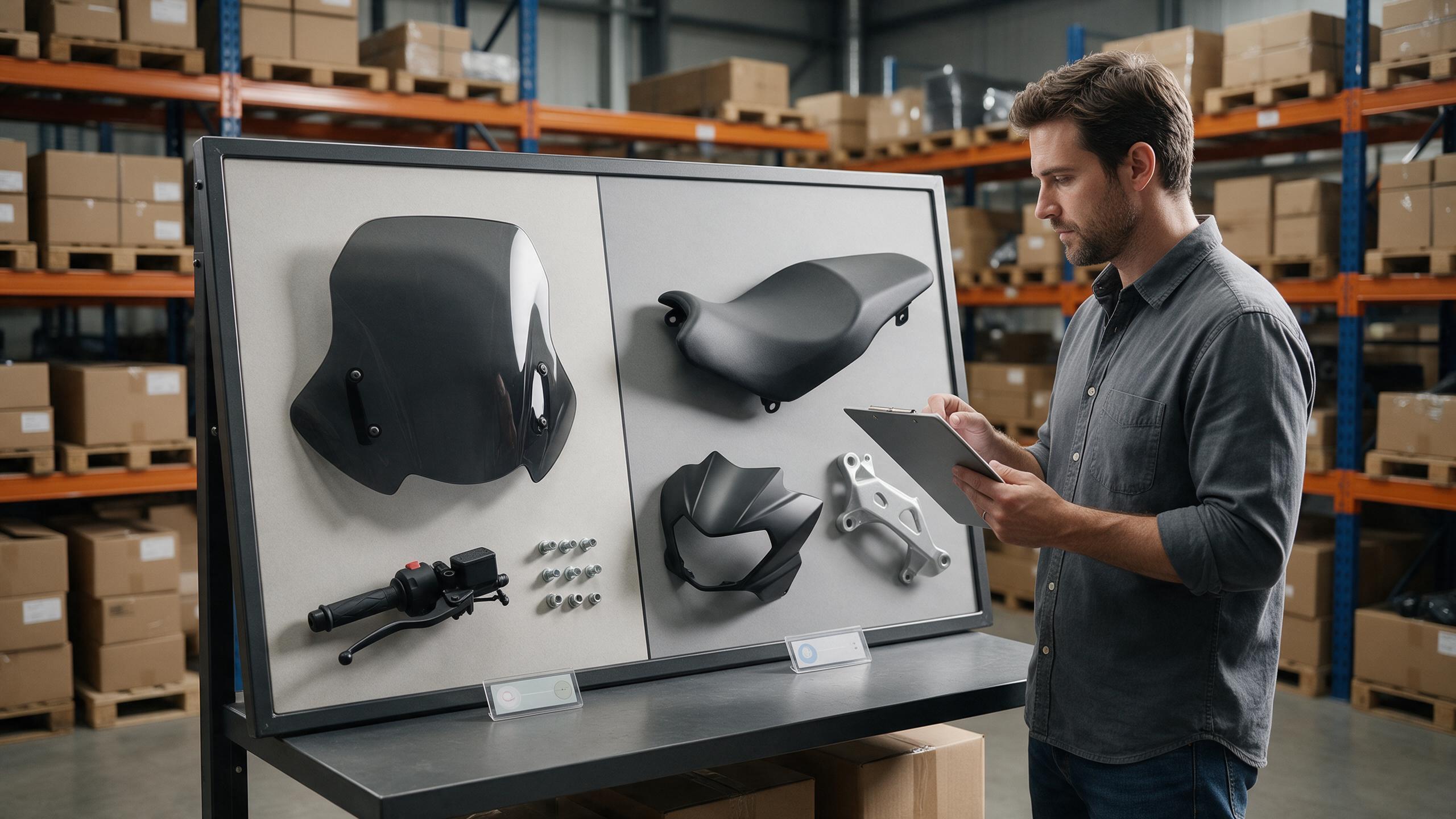
Model-Specific Moto Modification Parts deserve earlier inventory space when there is evidence of repeat demand and the fitment path is controlled. The more closely a part relates to a motorcycle’s frame, bodywork, controls, lighting position, or electrical layout, the more important vehicle-specific verification becomes. A distributor should not treat a model name alone as sufficient; year, trim or configuration, installation location, and relevant dimensions may also matter.
These Motorcycle Accessories can help a channel partner answer a more precise buyer request, but they increase catalogue maintenance. Each SKU should have a clear fitment basis, a review date, product images that do not substitute for specifications, and a process for resolving exceptions. If that process is not available yet, begin with a smaller tested set rather than expanding into many similar-looking parts.
A practical first-stock split
There is no fixed ratio that fits every territory or distributor. A sensible opening approach is to stock a controlled core of Universal Motorcycle Accessories, then reserve model-specific purchases for combinations of verified demand and usable fitment data. This creates a lower-complexity foundation while leaving room to respond to focused enquiries.
| Inventory question | Universal-first signal | Model-specific-first signal |
|---|---|---|
| Demand pattern | Requests span several motorcycle types | Requests repeatedly identify the same vehicle family and use case |
| Information available | Dimensions, connection, mounting, and usage limits are clear | Year/configuration fitment and installation conditions are documented |
| Stock risk | One SKU can support several relevant applications | Demand evidence supports carrying the specific variation |
| Channel readiness | Partners need a simple comparison card | Partners can collect complete fitment details before ordering |
This is a planning tool, not a promise of sales performance. The purpose is to make the trade-off visible: more universal coverage can reduce SKU complexity, while targeted Model-Specific Moto Modification Parts may improve relevance where the distributor has the data and demand to support them.
Use a four-field gate before adding a SKU
- Demand evidence: Record the motorcycle type, product purpose, requested quantity, and whether the request recurs.
- Fitment evidence: Separate confirmed dimensions or vehicle data from assumptions based on appearance.
- Channel evidence: Decide whether wholesalers, stores, or online sellers can present the needed confirmation fields.
- Replenishment evidence: Keep packaging quantity, variations, lead-time questions, and substitute options visible in the SKU record.
Applying this gate to Motorcycle Accessories helps a distributor compare the cost of carrying an item with the cost of explaining, correcting, or replacing a mismatched choice. It also gives sales teams a repeatable way to ask for the information that changes the recommendation.
Build catalogue content around verification, not claims
For Universal Motorcycle Accessories, list the dimensions, mounting context, electrical or connection requirements where relevant, package contents, and any conditions buyers must check. For Model-Specific Moto Modification Parts, add the confirmed vehicle scope and retain a clear “confirm before order” path for any field not supported by current records.
Distributors serving wholesalers, agents, physical stores, and online sellers benefit from reusable comparison fields. A small set of consistent fields—application, fitment basis, installation position, variation, package quantity, and confirmation status—can make Motorcycle Accessories easier to list and review across channels. The motorcycle and auto accessories resource can support further category exploration, while product-level details should still be checked before an order is placed.
What to stock first
Start with Motorcycle Accessories that have broad but clearly documented use conditions, then add model-specific lines where demand and fitment records meet. Do not frame universal as automatic fit or model-specific as automatic priority. The better first assortment is the one a distributor can describe accurately, verify efficiently, and adjust as enquiries reveal which vehicle-specific needs are recurring.
Before the next purchase order, ask: Which Motorcycle Accessories have complete specifications? Which requests repeat by motorcycle family? Which details are still unknown? Answering those questions first creates a more usable range of Universal Motorcycle Accessories and a more disciplined path into Model-Specific Moto Modification Parts.
 Hot News




