EN

Which European and Japanese Vehicle Brands Need the Most Distinct Car Clip Geometries?
For a wholesale buyer, a Car Clip should not be treated as a generic plastic fastener just because it looks familiar. European Japanese OEM Car Clip requirements can become highly specific when a trim panel, bumper liner, splash shield, pillar garnish, or interior panel uses a distinct hole size, panel thickness, head profile, or insertion direction. The practical question is not which badge is “hardest,” but which vehicle application leaves the least room for a geometry mismatch.
As a purchasing exercise, start with the repair location and vehicle identity, then compare the retainer. A make and model name alone is rarely enough. Model year, trim level, body style, panel location, and the original part reference can all change what a Vehicle-Specific Trim Panel Retainer needs to do.
Why brand alone cannot rank Car Clip complexity
It is tempting to say that European vehicles need distinct clips while Japanese vehicles use simpler ones, or the reverse. That conclusion is too broad to support a reliable order. Both groups contain long model ranges, regional versions, facelifts, and trim systems that use many fastening strategies. What makes a Car Clip distinct is the application geometry, not the brand name printed on the vehicle.
Complexity rises when the original retainer combines several constraints: a narrow hole tolerance, an unusual stem or barb profile, a shaped head that sits flush behind trim, a captive-seal feature, a threaded or screw-receiving center, or a removal direction that protects a finished panel. A visually similar clip can enter the hole yet still sit proud, rotate, rattle, release under vibration, or damage the panel during removal.
In other words, use brand families as a sourcing filter, not as a fitment verdict. A European Japanese OEM Car Clip request becomes more distinct when the buyer can identify its exact mounting task.
Where European vehicle applications often need closer geometry checks
European vehicle lines often reward detailed checking because exterior and interior trim may be integrated with insulation pieces, wheel-arch liners, underbody panels, door cards, or multi-part garnish assemblies. That does not mean every clip is unique. It means the supplier should not substitute a generic push retainer without matching the original geometry and installed position.
Trim systems with low visual tolerance
Door panels, dashboard side trims, pillar covers, and visible bumper pieces can expose even a small head-profile difference. Here, record the head diameter and shape, the stem length, the insertion depth, and any collar or sealing feature. The right Vehicle-Specific Trim Panel Retainer should support the panel’s intended stand-off and load direction rather than merely fill the hole.
Underbody and wheel-area positions
Wheel-arch liners and lower shields may use clips that work with different material thicknesses or mounting directions. A Car Clip for one liner location should not be assumed to fit the next point on the same vehicle. Compare the hole diameter, the stack thickness of the joined parts, the stem’s engaged length, and whether the original has a center pin, screw contact point, or a washer-like flange.
Where Japanese vehicle applications often demand exact matching
Japanese vehicle platforms also use application-specific retainers across bumper covers, engine-bay covers, door trims, rocker mouldings, and interior panels. The sourcing challenge is often the volume of closely related clips: two retainers may share a material and color while differing in head diameter, barb spacing, or stem length. That is enough to make an assortment-based substitution unreliable.
Dense part-family variation
Many repair jobs involve repeatable-looking push pins, but the exact Car Clip can vary by model year or by mounting point. Do not let a shared vehicle brand override the original sample or parts reference. First check the hole and panel; then inspect the clip body. If the clip has a separate pin, measure both the outer body and the pin relationship.
Interior finish and serviceability
For interior applications, the removal path matters as much as retention. A Vehicle-Specific Trim Panel Retainer may be designed to release in a controlled way so the panel can be serviced without stressing a visible edge. When no verified technical drawing is available, ask for clear front, side, and installed-position photographs plus the removed original part before approving a substitute.
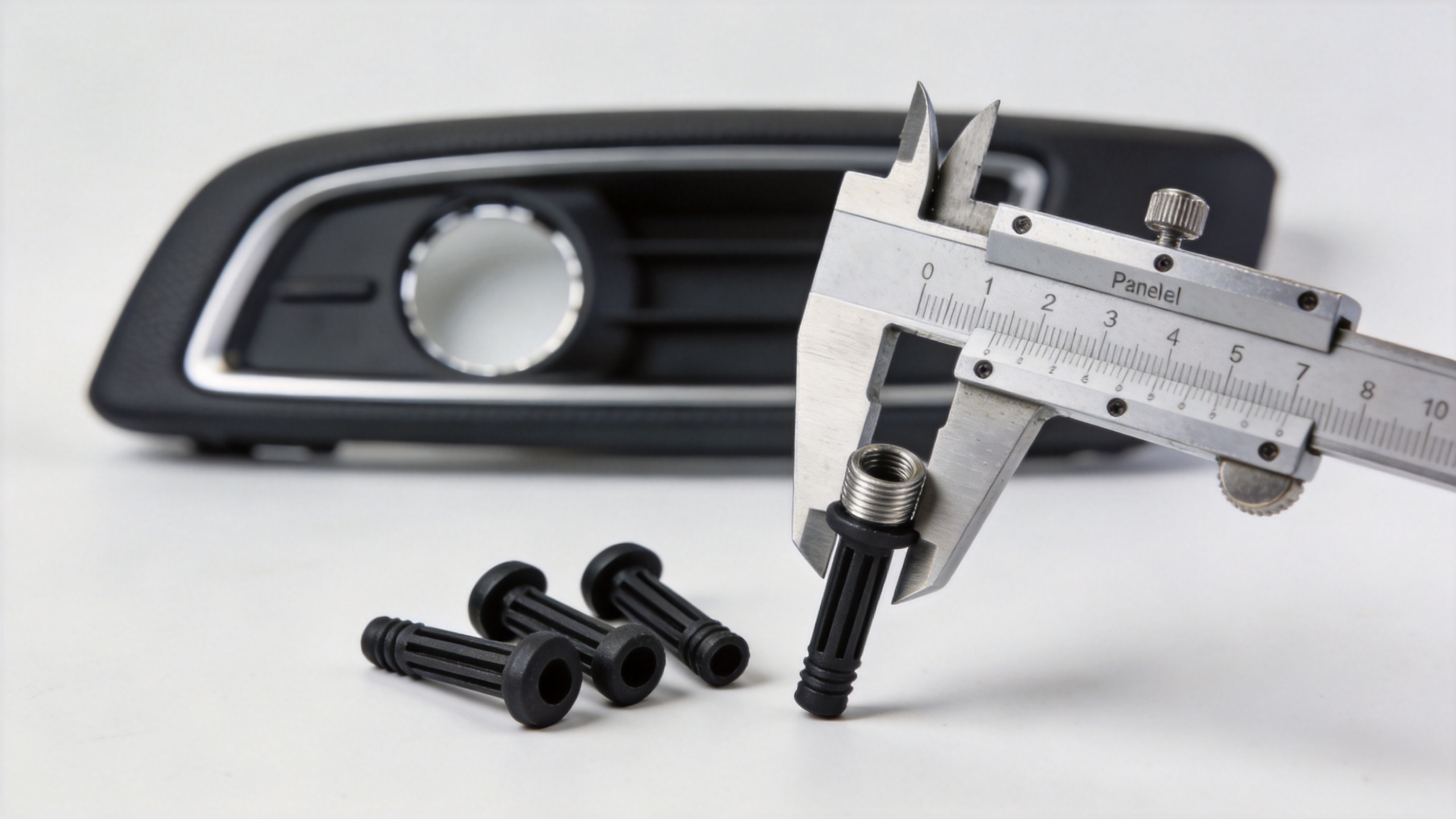
The geometry fields that make a Car Clip truly vehicle-specific
Catalogs commonly distinguish retainers by concrete dimensions such as hole diameter, head diameter, stem diameter, and stem length. Those fields are useful, but they are a starting point rather than a complete fitment record. For a European Japanese OEM Car Clip, capture the following comparison set:
- Vehicle application: make, model, model year, body style, trim, and the exact panel location.
- Original reference: OEM part number when available, plus photographs of the removed clip and its installed orientation.
- Receiving hole: measured hole diameter, shape, and whether the hole is in metal, plastic, liner material, or a layered assembly.
- Panel stack: panel thickness, combined material thickness, and the required stand-off distance.
- Clip body: head diameter and profile, stem diameter and length, barb count or fin profile, collar, seal, and center-pin or screw details.
- Service condition: insertion direction, expected removal method, nearby trim sensitivity, and whether the clip is intended for one-time replacement.
Photos help identify form, but they cannot replace measurement. A clip with an 8 mm hole requirement and one with a 9 mm hole requirement can look close in an image while behaving differently after installation. Likewise, a longer stem is not automatically better; it may bottom out, leave a gap, or interfere with adjacent parts.
A practical sourcing workflow for distinct retainers
- Define the repair point. State whether the Car Clip secures a bumper, liner, door trim, undertray, garnish, or another panel.
- Collect vehicle identifiers. Include make, model, year, body style, and trim where known. Add the original reference instead of relying on a brand name alone.
- Measure the original and the receiving feature. Record the geometry fields above with units and tolerance notes where possible.
- Compare the retention design. Match the barb profile, flange support, stem reach, and removal behavior to the actual application.
- Validate with a sample. Use a physical trial on the relevant panel before a bulk order, especially for visible trim or locations exposed to road debris and vibration.
- Keep the result in a fitment table. Link each approved clip to the vehicle scope, position, photo set, measurements, and any replacement notes.
For distributors and online sellers building a repeatable catalog, this workflow keeps the approval record usable when the next inquiry arrives. It turns a vague “fits European and Japanese cars” claim into a reviewable record of where a Car Clip has actually been checked.
How wholesalers can organize a European Japanese OEM Car Clip range
A broad assortment still has a role for workshops and general repair stock, but it should be presented honestly as an assortment. For model-specific requests, group stock by application evidence rather than appearance alone. One list can cover common push-type retainers; a separate fitment file can document distinct clips by vehicle family, panel location, and measured geometry.
For a Vehicle-Specific Trim Panel Retainer inquiry, request the vehicle details, original part reference, dimensions, panel location, and expected quantity before quoting. If any of those inputs are missing, the responsible answer is to mark the match as pending verification. This reduces repeated clarification after samples have already been shipped.
Yiwu Shengying Auto Accessory Co., Ltd. supplies automotive accessories for wholesale-oriented buyers. For a clip inquiry, provide the application record and retained sample information so the comparison can focus on fitment requirements rather than a generic visual match.
Conclusion: specialization is a geometry question
Neither European nor Japanese vehicle brands can be placed in a single reliable “most distinct” ranking for every Car Clip. Both can require precise retainers when trim design, panel construction, hole size, stem reach, or service access changes. The strongest purchasing method is therefore simple: identify the vehicle and repair location, measure the original and the receiving hole, compare the full retention geometry, and approve a sample before scaling the order.
It keeps a European Japanese OEM Car Clip request tied to the available evidence and gives buyers a clearer route to the right Vehicle-Specific Trim Panel Retainer for each application.
 Hot News