
 EN

Are Color-Coded OEM Replacement Car Clip Sets Easier for Mechanics to Identify During Repairs?
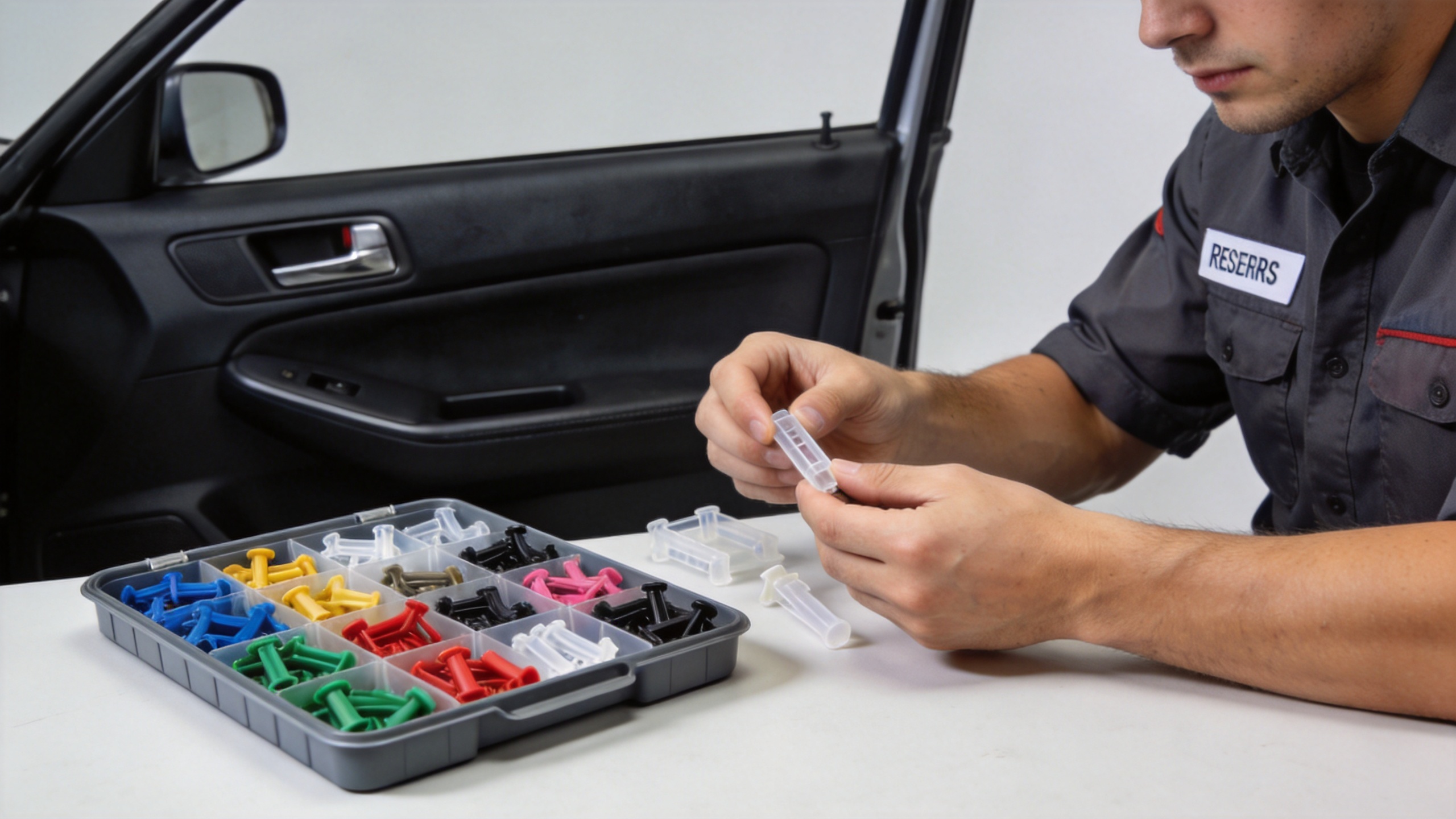
A mixed tray of retainers can slow an otherwise straightforward trim job. A color-coded Car Clip set can make the first sorting pass faster because the technician can group visibly different pieces before checking their shape. That is useful when bumper liners, splash shields, door cards, and interior trim have released several similar-looking fasteners. Still, color is a navigation aid, not a fitment verdict. The right Car Clip must match the vehicle location and the physical features of the removed part.
For mechanics, body shops, and parts resellers, the practical answer is yes: a well-organized color-coded set is easier to identify during repairs when its color system is consistent within that kit. It reduces visual search time and makes it easier to put removed pieces back into labeled groups. It does not replace comparing the head, stem, locking legs, hole size, or panel thickness.
Why a color-coded Car Clip set helps at the workbench
A repair rarely begins with a pristine vehicle. The original Car Clip may be dusty, distorted, broken, or mixed with hardware from a previous repair. In that setting, a visual cue gives a technician a quick way to separate families of retainers. If one color is repeatedly assigned to a push-type trim retainer and another to a screw-type retainer, the tray becomes easier to scan than a single pile of black plastic parts.
A Color-Coded OEM Car Clip Set can also support a more orderly removal process. Before reinstalling a bumper cover or door panel, a technician can place each removed Car Clip into a compartment, note the panel location, and compare it with replacement candidates. That habit is especially helpful when one vehicle uses multiple fastener diameters along the same panel.
Color has a second benefit for team work. A technician can tell an assistant to bring the blue group or the red group while the original sample remains at the vehicle. The wording is only useful, however, if everyone is referring to the same kit map. Color meanings are not universal across the automotive aftermarket, so a color label should always be paired with a part description or dimensions.
What color can tell you—and what it cannot
Color is helpful for sorting, inventory control, and visual recall. It may distinguish a broad family in a particular assortment, such as clips intended for an interior panel versus clips intended for an underbody shield. It can also make a missing compartment obvious after a job. These advantages explain why an Automotive Bumper Door Panel Retainer assortment with clear tray labels is easier to use than an unmarked bulk bag.
But a Car Clip cannot be selected by color alone. Two retainers may look similar yet differ in stem length, collar depth, head diameter, leg profile, or expansion method. A clip that enters the mounting hole may still sit too loosely, hold the panel at the wrong stand-off, or damage the panel during installation. The original location and profile matter more than the color.
Color can also change with age, heat, dirt, and previous refinishing work. A mechanic should treat an aged sample as a shape reference first. If the original part is missing, inspection of the empty hole, the panel material, and neighboring fasteners provides a stronger basis for choosing the next Car Clip.
A reliable five-step identification routine
- Record the location. Note whether the fastener came from a bumper edge, wheel-arch liner, door card, trunk trim, engine-bay cover, or interior garnish. The position narrows the likely Car Clip function.
- Keep one original sample. Even a damaged retainer can reveal the head shape, stem length, and locking-leg geometry. Photograph it beside a ruler when a parts request is needed.
- Use color to find the candidate compartment. In a Color-Coded OEM Car Clip Set, use the tray map to locate the candidate group quickly. This is the speed benefit, not the final confirmation.
- Compare the physical contact points. Check the panel-hole diameter, head coverage, stem reach, and whether the clip snaps, expands, screws, or slides into place. Test fit without forcing the part.
- Install and inspect the panel. After fitting the Car Clip, make sure the panel lies evenly, the fastener seats without excessive force, and adjacent parts move normally.
Where color-coded Car Clip assortments are most useful
Color-coded assortments are particularly useful in jobs with many small fasteners removed in sequence. Bumper cover work can involve edge retainers, liner clips, and lower-shield clips within a small area. Door trim work may include separate retainers for the panel, vapor barrier, and cable guides. In both cases, color helps a technician return to a known group after the work area has been interrupted.
They are also helpful for mobile repair teams and wholesalers who pack service kits for different customer groups. A tray that pairs a color, diagram, and dimensions gives the user several ways to identify each Car Clip. For a distributor, that can reduce questions about which compartment a customer used; for a workshop, it can make restocking more systematic.
How to source a workable Car Clip set
Ask for a kit layout that describes each Car Clip by application, dimensions, and fastening style. Clear compartment labels are more valuable than an attractive color scheme with no reference information. For vehicle-specific repair work, compare the replacement against the removed sample and applicable service information before ordering in volume.
Yiwu Shengying Auto Accessory Co., Ltd. serves wholesalers, agents, physical stores, and online sellers in automotive accessories and customized parts. For a clip assortment inquiry, providing the vehicle model, installation position, panel-hole size, sample photos, and estimated order quantity gives a supplier a clearer starting point for confirming the appropriate Car Clip options.
Frequently asked questions
Does the same Car Clip color fit every vehicle?
No. Color coding is usually specific to an assortment or supplier’s organization system. Confirm the physical dimensions and mounting style before installation.
Can a color-coded set replace an OEM part-number check?
No. A color-coded Car Clip set speeds sorting, but a part-number or fitment check remains useful when the repair requires a precise replacement.
Are these sets only for bumper work?
No. A Car Clip assortment can be useful for bumpers, liners, door panels, trunk trim, underbody covers, and interior panels, provided the individual retainer matches the application.
The practical conclusion
A color-coded Car Clip assortment makes identification easier because it turns a crowded parts tray into visual groups. The gain is real during teardown, sorting, and reassembly. A sensible workflow is to use color to find candidates, then verify geometry and application before fitting the Car Clip. That combination supports faster repair organization while keeping fitment decisions grounded in the part itself.


 Hot News




