
 EN

How Can Wiring Harness and Fuel Line Fastener Clip Organizers Prevent Engine Bay Chafing?
An engine bay can look orderly at a glance while a harness or hose slowly rubs against a bracket, edge, or moving part. A Fastener Clip does more than hold a line in a convenient place: when the fit and location are right, it manages movement, keeps a defined route, and makes later inspection easier. The point is not to force every run into a rigid path. It is to control the motion that creates repeated contact.
For wholesalers, installers, and parts buyers, the useful question is not simply whether a Fastener Clip fits a hole. It is whether the clip, bundle, panel thickness, and installed route align in use. That distinction matters around a Wiring Harness Fastener Clip and a Fuel Line Routing Cable Clamp, where an apparently small clearance issue can become a service concern after heat cycles and vibration.
Why engine-bay chafing begins
Chafing is usually a movement-and-contact problem. A loom can sag until it rests on an abrupt stamped edge. A fuel line can drift toward a hose clamp, accessory bracket, or hot surface. A loose branch of the harness may move only a few millimeters, but the same contact point is revisited through many vibration cycles. Physical protection of wiring harnesses is a recognized engineering topic; routing hardware is one part of that larger protection system.
A Fastener Clip helps by establishing a repeatable relationship between the line and its mounting surface. It should hold the bundle without crushing it, keep the intended route clear of known hazards, and allow the installer to check whether the run is still seated after service. It cannot correct damaged insulation, a cracked hose, or an unsuitable route by itself.
Three contact patterns worth finding first
- Edge contact: a harness crosses a panel edge, bracket corner, or unfinished opening.
- Motion contact: a branch can swing into a pulley area, linkage, fan shroud, or adjacent assembly.
- Heat and service contact: a line sits too close to a heat source or is trapped where future service pulls it sideways.
These checks give a Fastener Clip a job to do. If the suspected rubbing point is not identified first, adding clips can merely lock an already poor route into place.
How a Fastener Clip organizes a harness route
Start with the route, not the clip catalog. With the engine off and cool, follow the harness from one supported point to the next. Look for unsupported spans, places where the loom drops under its own weight, and sections that can touch nearby hardware when gently moved by hand. A Wiring Harness Fastener Clip is useful when it keeps the loom clear of a hazard while respecting the harness bend and connector access.
Next, identify the mounting condition. Hole diameter, panel thickness, available backside clearance, and the orientation of the clip all affect retention. A Fastener Clip that enters a hole loosely can work free; one selected for the wrong panel thickness may not seat as intended. When a drawing or verified part specification is unavailable, treat fitment as an item to confirm rather than an assumption.
Bundle diameter matters as well. A clip channel that is too tight can pinch a loom or make later removal difficult. One that is too large may allow enough play for contact to return. The practical target is supported routing with a sensible amount of service movement, not tension on wires or hose.
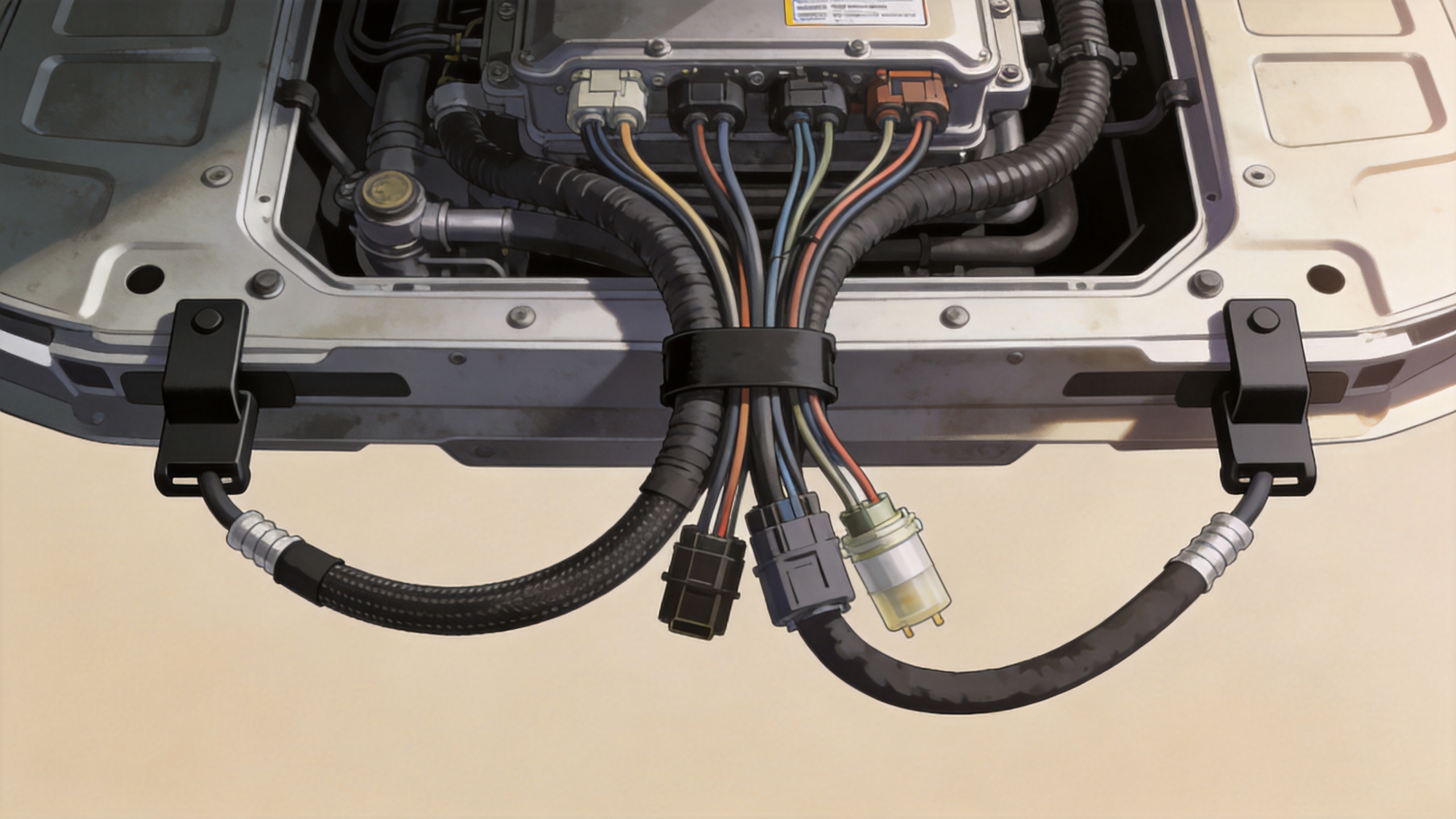
Fuel-line routing needs a separate check
Fuel-line materials and constructions vary, so a Fuel Line Routing Cable Clamp should not be selected on appearance alone. Inspect the actual outside diameter, line type, mounting location, and nearby heat or abrasion hazards. Check the vehicle or equipment service information when it is available. If a line shows cuts, nicks, seepage, stiffness, or other damage, routing hardware is not a substitute for an appropriate repair decision.
A Fastener Clip used near a fuel line should keep the route deliberate without introducing a concentrated compression point. Confirm that the mounting point is structurally suitable and that the line is not being pulled into a bend or against a component that moves during normal operation. After installation, recheck the route with nearby covers and service parts restored; a clear path in an open bay may change when those parts return.
A practical Fastener Clip inspection sequence
- Map the run. Trace each harness or line from support point to support point and mark unsupported spans.
- Find the hazard. Look for edges, moving components, heat exposure, and points that show polish, dust marks, or worn loom covering.
- Measure the mounting relationship. Record the mounting-hole size, panel thickness, bundle or line diameter, and required orientation before choosing a Fastener Clip.
- Test the seated condition. Once installed, check that the Fastener Clip is fully seated and the route is not under tension.
- Check service clearance. Refit adjacent covers or components, then confirm that normal access does not pull the run across a hazard.
- Reinspect after use. During routine service, check whether the Fastener Clip, loom covering, and contact clearances still look consistent.
Questions buyers should ask before ordering
For a purchasing team, describing a Fastener Clip as “universal” is seldom enough. Ask for the hole diameter range, compatible panel thickness, channel or bundle diameter, material, mounting orientation, and any available installation drawing. For a Wiring Harness Fastener Clip, add the loom diameter and route location. For a Fuel Line Routing Cable Clamp, add the verified line diameter and the expected environmental conditions.
This information also helps distributors and online sellers present clips in a way that supports fitment review. Yiwu Shengying Auto Accessory Co., Ltd. can use a structured inquiry that asks for the installation position, dimensions, and use case before a buyer regards a generic Fastener Clip as a confirmed replacement. That approach is more useful than promising a fit without vehicle-specific evidence.
When routing hardware is not the whole answer
A Fastener Clip is a routing aid, not a diagnosis. Stop and seek qualified technical help if electrical insulation is exposed, a fuel line is damaged or leaking, a route crosses a high-heat area without validated protection, or the intended mounting surface is compromised. The right next step may involve a grommet, abrasion sleeve, repaired bracket, replacement line, or a revised harness route rather than another clip.
Used thoughtfully, a Fastener Clip supports a simple maintenance habit: keep each harness and line in a known route, inspect the places where motion meets structure, and confirm the dimensions before specifying a replacement. That routine can reduce avoidable rubbing risk while preserving the access needed for inspection and service.
 Hot News




