
 EN

Which Fastener Clip Assortments Cover Over 90% of General Collision Repair Needs?
No specific assortment can be identified as covering more than 90% of general collision repair needs from the evidence available here. Vehicle mix, repair locations and the definition of coverage all change the answer. A practical starting point is to compare a push-rivet assortment, a trim-retainer assortment and a separate selection of clip nuts against the jobs your own shop handles. Verify each fastener clip against the vehicle repair information and the attachment point before use.
For a purchasing team, a large piece count is less useful than a clear map of what each part fits. The same bin may contain several visually similar retainers with different hole sizes, grip ranges or locking shapes. Start with the work order and the original part, not the number printed on the box.
Choose assortments by attachment type, not kit size
A Collision Repair Fastener Clip Kit can be a starting point for non-structural trim work, but its contents need to match the specific tasks in your repair mix. Separate potential assortments into the following groups before comparing listings.
- Push-pin and expanding rivets: Consider these for attachment points that originally use that style, such as certain liners, covers or bumper trim. A center pin may spread the legs of a two-piece fastener clip. Confirm the relevant design and dimensions rather than assuming that all push fasteners work alike.
- Trim and molding retainers: Compare the head profile, attachment direction and engagement shape with the removed part and the panel. A retainer that looks close from above may attach differently underneath.
- Clip nuts and compatible screws: Keep these separate from plastic push retainers. They are relevant only where the original joint calls for a threaded clip and a matching screw; the screw and thread must be checked together.
- Vehicle-specific retainers: Treat unusual shapes, designated part numbers and special mounting positions as separate purchases. A mixed assortment is not a substitute for vehicle-specific repair instructions.
A Universal Auto Body Push Pin Assortment describes a category of kit, not a promise that every fastener clip will fit every vehicle. Ask for a component list with dimensions, locking style, material and part-number cross-reference where available. If those details are missing, request samples or clarification before committing to a bulk order.
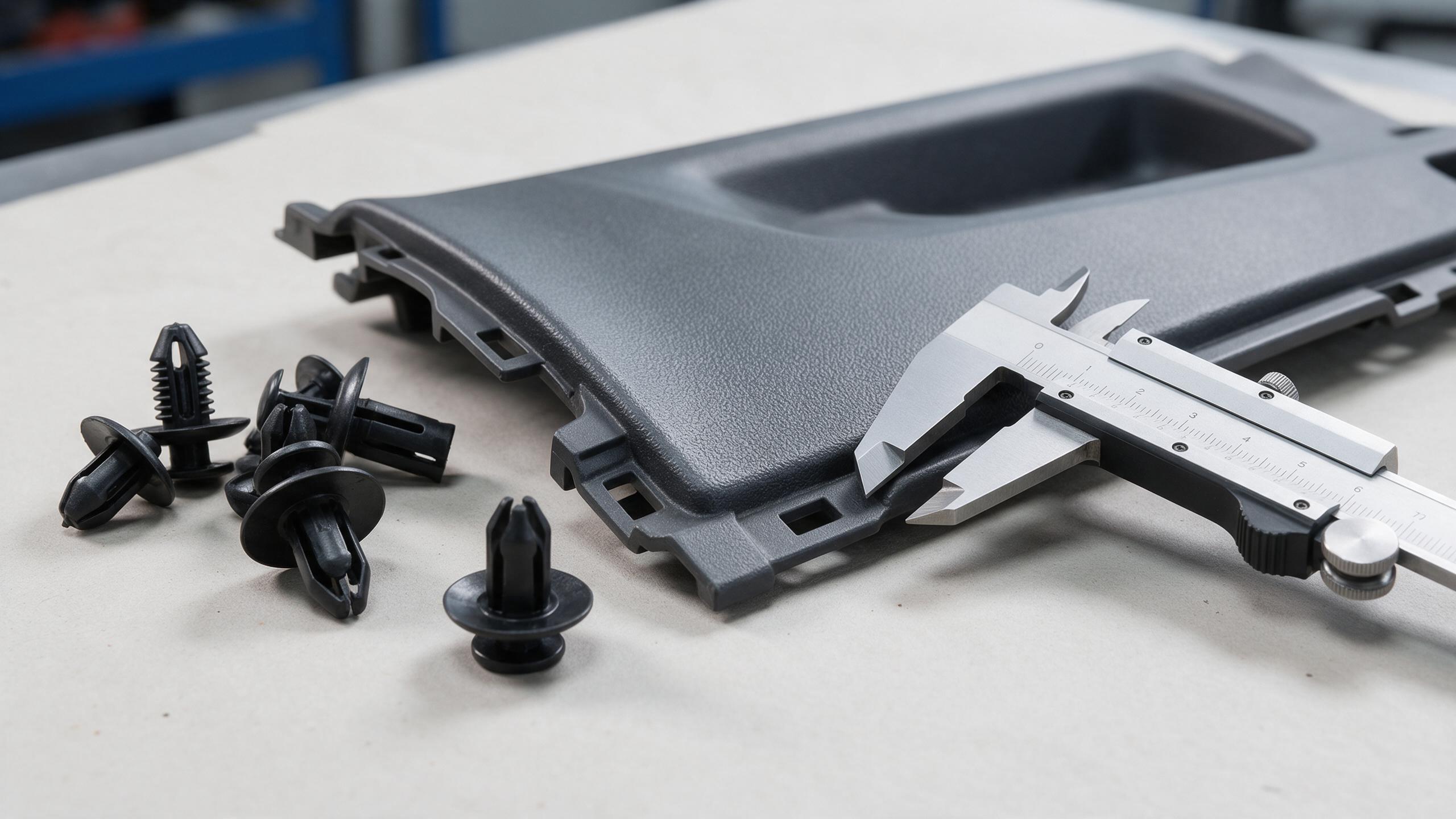
Measure the fastener clip and the joint
Before comparing a replacement, record the vehicle identification, model year, repair position and the original part number if it is available. Preserve an undamaged sample when possible. Then check the joint itself: an old fastener clip may have distorted during removal, so a sample alone may not be a reliable gauge.
- Hole diameter and shape: Measure the opening in each panel and check that the openings align. A round shank does not establish compatibility with a slot or a different shaped hole.
- Grip range: Measure the combined thickness of the material being held. The selected fastener clip must engage within the manufacturer's stated grip range; a correct hole diameter alone is not enough.
- Head and stem geometry: Compare head diameter, stem length, shoulder and clearance behind the joint. Make sure the head can sit on the intended surface without obstructing adjacent parts.
- Locking mechanism: Check how the original part engages and releases. A push pin, a threaded clip and a shaped trim retainer are not interchangeable merely because they appear similar.
- Condition and instructions: Inspect the mounting area for damage and follow the vehicle maker's repair procedure. Replace the fastener clip when required by that procedure; do not use a general assortment where a specified part is required.
Guidance from fastener supplier JET PRESS identifies hole diameter and combined panel thickness as key sizing dimensions for plastic rivets. Use that as a measuring framework, then verify the vehicle and replacement part details for the actual repair. Do not force a fastener clip into an opening to make it appear secure.
How to test a coverage claim for your shop
The phrase “over 90%” needs a defined denominator. Does it refer to individual fasteners, attachment points or complete repair jobs? Those measures can produce different results. A kit can contain one usable fastener clip for a job while still lacking another specified retainer needed to finish that job.
For a job-level measure, review a representative set of completed repair orders from a defined period. Record each vehicle, attachment location and required fastener clip type. For each job, mark it covered only if the proposed assortments contain all the specified fasteners needed for the defined scope, in the necessary quantities, and each has an acceptable fit or documented part-number match. Count a job with an unknown or unverified match as not confirmed, not as covered.
Divide confirmed covered jobs by the total eligible jobs reviewed and multiply by 100 to express the result as a percentage. Keep the scope, dates, excluded work and evidence with the calculation. This is a method for evaluating a local claim, not proof that any named kit meets a threshold. Recheck the figure when the vehicle mix or repair scope changes.
Set up a usable purchasing and replenishment list
Once you know which attachment types recur in your records, compare a Collision Repair Fastener Clip Kit with separate refills for those verified types. Record the supplier's part identifier, head and stem dimensions, grip range, material, quantity and any documented vehicle cross-reference. Put uncertain applications in a separate review column. Avoid describing a candidate as an exact replacement until the required fit has been checked.
When comparing two kits, count distinct verified types as well as pieces per type. A box with many copies of a few shapes may suit a narrow workload; another with more shapes but very few of each may need frequent refills. Neither box is inherently right without the shop's usage records. Keep a small record of shortages and unused bins, then update the reorder list using actual repair demand.
Wholesalers, repair suppliers and retailers can use the same checklist when discussing a Universal Auto Body Push Pin Assortment: request a dimensioned contents list, confirm packaging quantities, identify which applications are documented and ask how individual shapes can be reordered. Product availability and supply terms should be confirmed directly rather than inferred from an assortment name.
Before ordering or fitting
Start with verified vehicle information and a clearly defined repair scope. Compare the fastener clip mechanism, dimensions and grip range with the joint, then consult the applicable service procedure. If the attachment is damaged, the fit is uncertain or the procedure specifies a particular part, stop and obtain the correct guidance or component. A well-organized assortment can support routine work, but the coverage figure belongs to the evidence from your own measured repair mix.
 Hot News




