EN

Should You Source Mesh Network or Bluetooth 5.3 Motorcycle Helmet Intercom Systems for Group Rides?
For a wholesaler, distributor, or online seller, a Motorcycle Helmet Intercom is not a single-specification purchase. The right sourcing decision depends on how a riding group behaves, how products join and leave a conversation, and whether the supplier can document those behaviors on the exact SKU you plan to buy. A small touring pair, an instructor-led group, and a loose weekend club can all use a Motorcycle Helmet Intercom, but they do not create the same technical or commercial requirements.
Start by separating two labels that are often mixed together. Mesh describes a network approach for rider-to-rider conversation. Bluetooth 5.3 describes a version of the Bluetooth Core Specification. A listing that says “Bluetooth 5.3” does not, by itself, confirm a particular group topology, rider capacity, range, or cross-brand behavior. The Bluetooth SIG introduced Core Specification 5.3 in 2021, including optional LE improvements such as Connection Subrating for certain use cases. That is useful context, but it is not a substitute for an intercom test plan.
Begin With the Ride Pattern, Not the Version Number
A Motorcycle Helmet Intercom for a couple riding within sight of each other can prioritize simple pairing, clear controls, and a practical phone connection. A system intended for a six-rider club needs a different brief: riders may change order, pause for fuel, move behind terrain, or join after the ride has started. The buyer should define the expected group size, spacing, terrain, helmet types, and whether a ride leader needs to address everyone at once before requesting quotations.
For B2B sourcing, write those conditions into the RFQ. Ask the factory to state whether the quoted Motorcycle Helmet Intercom supports direct one-to-one pairing, a chained multi-rider session, a proprietary mesh group, or more than one mode. “Group communication” is too vague to compare suppliers fairly.
What a Mesh Network Motorcycle Helmet Intercom Changes
A Mesh Network Motorcycle Helmet Intercom is generally worth investigating when the main value is keeping a larger, changing group connected. In a mesh design, participating units may act as network nodes rather than relying on one fixed sequence of riders. That architecture can make a group more tolerant of a rider leaving or rejoining, but the actual outcome depends on the protocol, radio implementation, rider spacing, obstacles, firmware, and the manufacturer’s definition of a group.
That distinction matters during sourcing. Do not turn the word “mesh” into a promise that every group will hear every rider under every condition. Instead, request a demonstration with the same number of units you expect to package, place riders in a moving line and a spread-out formation, and ask the supplier to show the rejoin sequence when a middle rider disconnects. Record the firmware version, mode used, headset model, and test environment. This turns a Motorcycle Helmet Intercom claim into a repeatable sample-approval checkpoint.
Mesh can also create a commercial constraint: groups may need units using the same compatible mesh implementation. Before allocating stock, ask whether the supplier’s range includes compatible replacement units, whether firmware updates can change interoperability, and how the seller should explain compatibility on a product page. A distributor should not assume that two products described as mesh will communicate merely because both use that word.
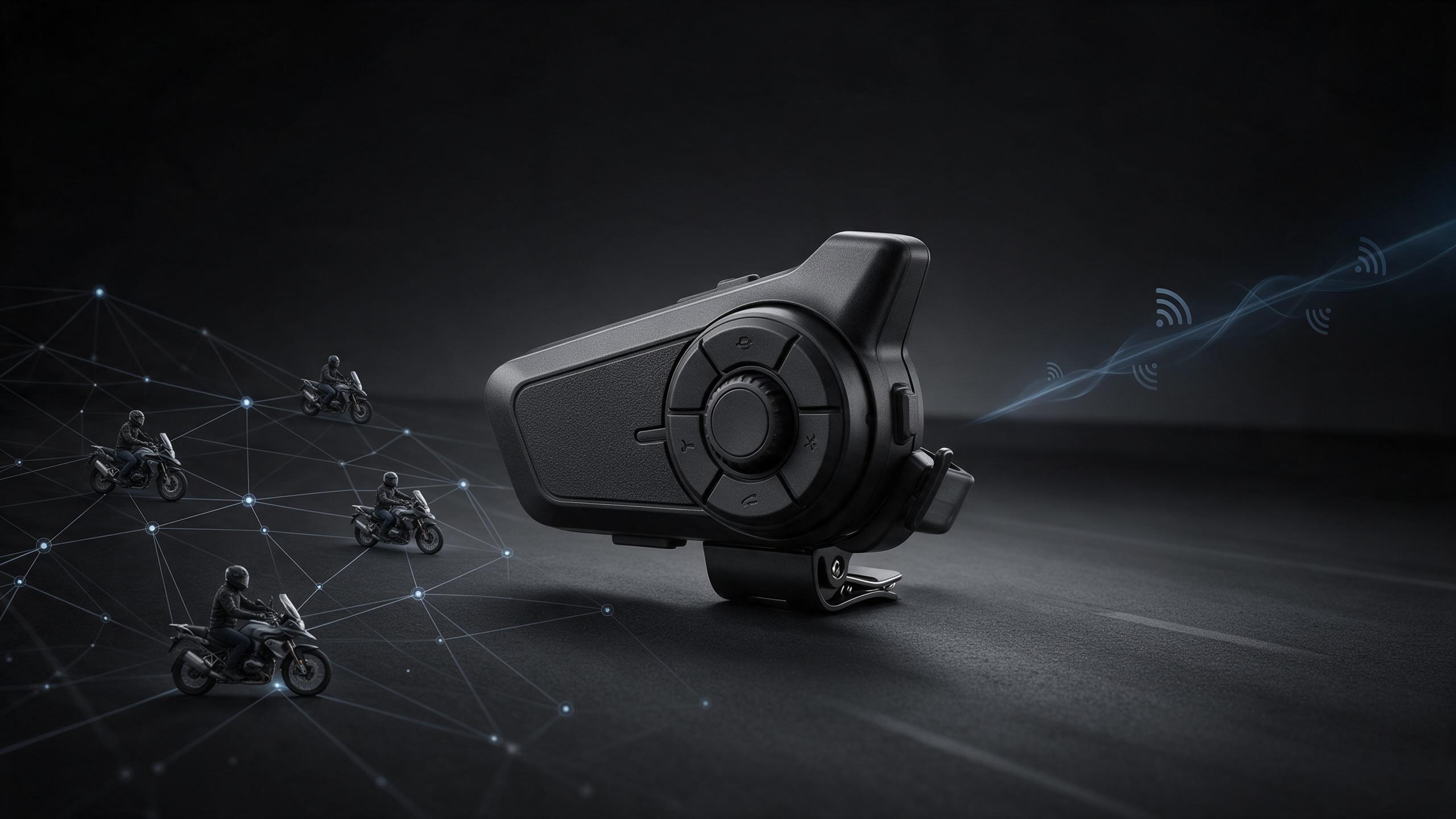
Where a Bluetooth 5.3 Group Ride Communicator Fits
A Bluetooth 5.3 Group Ride Communicator may fit a smaller or more predictable ride group, especially where buyers value phone pairing and a simple, familiar connection process. But Bluetooth 5.3 should be treated as a component or specification question, not a complete answer to the group-ride question. Ask which Bluetooth functions the product actually implements and which functions apply to rider-to-rider voice rather than phone, navigation, or music control.
For a Motorcycle Helmet Intercom sold as a Bluetooth 5.3 Group Ride Communicator, request a plain-language pairing map. It should show the advertised number of simultaneous riders, the required pairing order, what occurs when an intermediate rider drops out, how a new rider joins, and whether the product switches modes during a call. If the supplier cannot show that workflow on a sample, the version number alone adds little purchasing confidence.
Bluetooth-based group systems can still be a sensible range choice. They may suit dealers serving two-up riders, training partners, or compact groups that keep a stable formation. The important point is to describe the use case honestly. A Motorcycle Helmet Intercom should be matched to the group’s operational pattern, not sold on a label that buyers may interpret more broadly than the evidence supports.
Use a Sourcing Matrix Instead of a Feature List
A practical comparison sheet helps procurement, sales, and quality teams reach the same decision. Score each Motorcycle Helmet Intercom sample against the following questions:
- Topology: Is it one-to-one, chained group communication, proprietary mesh, or a documented hybrid?
- Group workflow: How are units invited, removed, muted, and rejoined while the group is active?
- Compatibility: Which exact models, firmware versions, and modes work together? Is universal Bluetooth pairing separate from group intercom?
- Acoustics: Can the supplier demonstrate microphone placement, speaker fitment, wind-noise behavior, and volume controls in the helmets your channel sells?
- Physical fit: Which helmet shell shapes, clamp positions, adhesive mounts, speaker recesses, and cable routes have been checked?
- Power and controls: What charging connection, battery indication, glove-friendly button layout, and power-off behavior are documented?
- After-sales evidence: Are manuals, troubleshooting steps, firmware instructions, spare mounts, and warranty terms available for the SKU?
This approach is more useful than comparing a Motorcycle Helmet Intercom only by an advertised maximum figure. Real group behavior involves configuration, rider position, terrain, audio expectations, and user training. The same applies to range claims: ask how the figure was measured and treat it as a test condition to reproduce rather than a universal outcome.
Sample-Test the Complete Group, Not One Unit
One common sourcing error is approving a Motorcycle Helmet Intercom after checking phone calls and music on a single sample. That verifies only a narrow part of the product. A more useful pilot uses the intended retail pack quantity, actual helmets, and several ride-like conditions. Assign one person to create the group, another to leave and return, and a third to operate navigation or a phone connection. Then note which actions require a manual repair of the conversation.
For a Mesh Network Motorcycle Helmet Intercom, ask the supplier to show how the group is built and restored after a member returns. For a Bluetooth 5.3 Group Ride Communicator, test the documented pairing order and any group limitations. Do this before confirming packaging copy, because packaging should reflect the tested workflow rather than a broad factory description.
Plan the Product Page and Channel Rollout
Once a Motorcycle Helmet Intercom is approved, publish the decision information buyers need. State the intercom mode, tested compatible models, included mounting parts, charging connection, instructions for building a group, and any items that require confirmation. Avoid implying that the product fits every helmet or connects with every communication system. Clear boundaries make it easier for retailers and marketplace teams to set accurate expectations.
For wholesale rollout, retain the sample checklist, final manual, packaging artwork, firmware reference, and support script together. If a later production batch changes a radio module, microphone, mount, or firmware, repeat the group test rather than assuming the original result applies. Product data consistency matters as much as an appealing feature list when dealers must explain the Motorcycle Helmet Intercom to riders.
Which Option Should You Source?
Choose a mesh-oriented option when your target customers regularly organize changing multi-rider rides and the supplier can document same-protocol joining, rejoining, and compatibility on the exact SKU. Choose a Bluetooth-oriented option when the expected group is small and stable, the pairing flow is easy to demonstrate, and phone integration is a core buying reason. In either case, make the purchase decision from sample evidence, not from a headline claim.
The most useful Motorcycle Helmet Intercom sourcing question is therefore not “mesh or Bluetooth 5.3?” It is: “Can this documented system support the group pattern our channel actually serves?” Build the answer from a written test plan, controlled samples, transparent compatibility notes, and a support package your resellers can use. That gives buyers a clearer basis for selecting a Motorcycle Helmet Intercom and gives your team a more defensible product launch.
 Hot News