
 EN

Should You Order PU Leather with Red Stitching or Carbon Fiber Trim for Your Car Armrest Box Line?
When a wholesale buyer builds a Car Armrest Box line, a finish is more than a decorative choice. It affects how the range is presented, how retailers explain the SKU, and which visual direction a buyer expects from the package. A PU Leather Car Armrest Box with red stitching and a Carbon Fiber Trim Auto Center Rest can both belong in a catalog, but they answer different merchandising questions.
From a wholesale purchasing perspective, begin with the vehicle, installation position, and target channel. Then compare the trim direction. Finally, request the SKU-level information that pictures alone cannot confirm. That order matters because a Car Armrest Box that looks appropriate for a sporty display still needs verified dimensions, fixing method, opening clearance, and included accessories before it can be assigned to a vehicle program.
Start with the product-line role, not the surface pattern
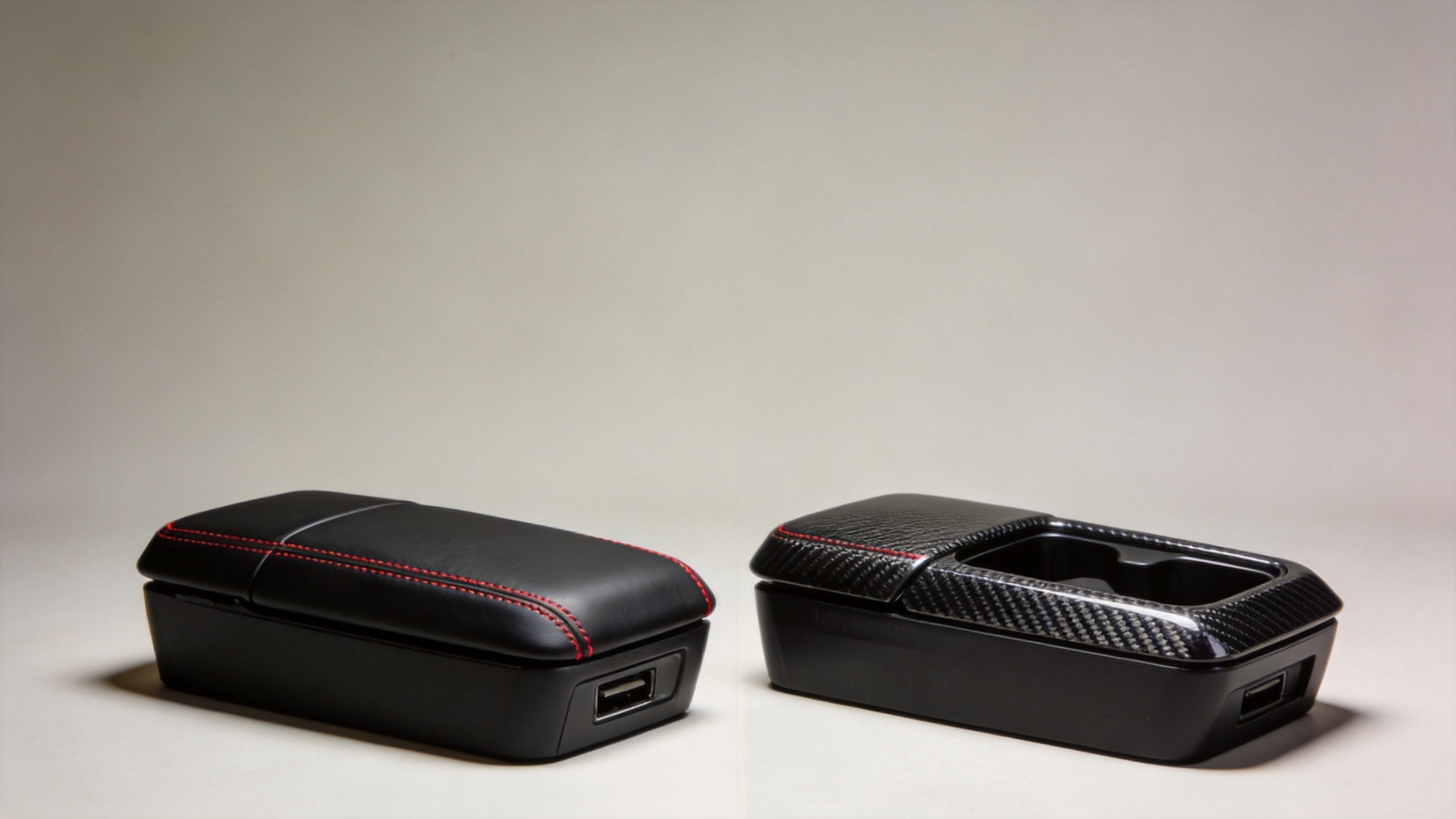
A red-stitched PU Leather Car Armrest Box usually signals a warmer, upholstered look. It can make sense when a retailer wants an interior accessory that feels coordinated with common seat-cover, steering-wheel-cover, or cabin-accent themes. A Carbon Fiber Trim Auto Center Rest points toward a sharper, technical visual language. It may suit a separate sport-styled group, especially when the channel needs a clear visual distinction between entry, comfort-oriented, and appearance-led options.
Neither direction should be treated as universally suitable. The right choice depends on the intended vehicle interior, the shopper profile, and the range architecture. For example, a compact catalog may use one finish to avoid duplicated listings. A wider Car Armrest Box program may use both finishes only when the underlying variants, imagery, and labels make the difference clear.
Compare the two trim directions by a buyer’s actual decision tasks
| Decision area | PU leather with red stitching | Carbon fiber trim |
|---|---|---|
| Visual message | A more upholstered, accent-led appearance; useful where cabin color coordination is part of the listing story. | A more technical, contrast-led appearance; useful where a sport-style visual theme is part of the listing story. |
| Catalog placement | Can sit beside comfort, storage, or interior-upgrade items when the approved sample supports that positioning. | Can sit beside appearance-oriented accessories when the approved finish and surrounding SKU presentation support it. |
| Retail explanation | Explain the visible stitch color and surface appearance, then state the fitment and construction details separately. | Explain whether the carbon-fiber effect is a trim treatment or another specified construction detail; do not let the pattern imply unverified specifications. |
| Approval focus | Check stitch color, stitch spacing, surface grain, edge finishing, and how the sample appears under normal product photography. | Check the pattern scale, direction, edge transitions, gloss level, and consistency across the approved sample set. |
The table is a comparison framework, not a claim that either finish has a particular performance level. A Car Armrest Box may share a visual theme across several listings while still requiring separate confirmation of its base, lid, storage layout, and installation arrangement.
Choose PU leather with red stitching when the range needs a cabin-accent story
A PU Leather Car Armrest Box with red stitching is often easier to frame around visible interior coordination. The contrast stitch gives sales staff and online listing teams a concrete feature to show in a close-up image. It can also help separate a red-accent option from a plain black option without changing the full catalog language.
Keep the description precise. “PU leather” should describe the approved surface specification for that SKU, not become shorthand for every part of the Car Armrest Box. Ask the supplier to identify which surfaces use the stated material, whether the stitch is functional or decorative, and what cleaning guidance applies to the finished sample. If these items are not documented, the listing should say less, not assume more.
This route is practical when a distributor expects customers to compare interior color accents. It is less useful when the only reason for the choice is a photograph. Images can help show appearance, but they cannot confirm fitment, fastening, opening movement, or the space left around cup holders and seat adjustments.
Choose carbon fiber trim when the range needs a distinct technical visual tier
A Carbon Fiber Trim Auto Center Rest can give a Car Armrest Box line a clear appearance-led tier. The pattern may help a buyer group sport-styled listings, create a different thumbnail language, or offer a visibly separate option to retailers that already sell performance-inspired interior accessories.
Describe the trim accurately. A carbon-fiber appearance does not, by itself, confirm what the trim is made from or how it is attached. Before allocating a Carbon Fiber Trim Auto Center Rest to a vehicle-specific listing, request the approved sample, finish reference, and SKU specification. Check whether the pattern direction is intentional, whether its sheen matches the supplied images, and whether the trim remains visually consistent around corners and lid edges.
In a broad market, a technical-looking finish may be one choice within the Car Armrest Box range. For a narrower retailer segment, it may be the lead visual. The merchandising decision should follow channel feedback and sample approval rather than a claim that one pattern suits every vehicle cabin.
Do not let styling replace fitment and use checks
For either finish, start with the higher-priority purchasing questions: Which vehicle, model year, and console footprint is the Car Armrest Box intended for? How is it fixed? Does the lid or top section interfere with existing controls, cup holders, seat movement, or normal access to the console? What is included in the package? A product that appears similar in a listing may differ in these points.
When reviewing a PU Leather Car Armrest Box or a Carbon Fiber Trim Auto Center Rest, use a sample checklist that separates appearance from installation:
- Confirm the exact SKU code and vehicle/console information.
- Photograph the trim, seams, edges, and lid from agreed angles.
- Verify the installation method and any supplied fixing parts.
- Check storage access and opening clearance in the intended location.
- Record the approved color and finish reference for repeat orders.
- Keep packaging, quantity, and accessory details separate from the visual description.
A simple ordering rule for a Car Armrest Box line
Use red-stitched PU leather when your range needs an upholstered accent that retailers can explain through cabin coordination. Use carbon fiber trim when the range needs a more technical-looking visual branch. If the two options would create overlapping listings with no clear shopper or channel distinction, begin with the one that matches your existing interior-accessory presentation and test the second option through sample review.
Before placing a bulk order, turn the decision into a short specification sheet. List the Car Armrest Box SKU, intended vehicle information, finish reference, dimensions, fixing method, storage layout, package contents, and items still awaiting confirmation. This gives purchasing, sales, and listing teams a usable finish decision without treating visual styling as a substitute for verified product information.

 Hot News




