
 EN

How Should Dealers Inspect Weave Alignment Before Accepting Wholesale Auto Carbon Fiber Parts?
Before accepting Auto Carbon Fiber Parts, compare the visible weave with an approved sample under agreed viewing conditions. Check its direction against a defined reference line, follow the pattern across important surfaces and matched pairs, and document any deviation before signing off. A striking finish is not an acceptance standard: the purchase order should say what is acceptable, where it is checked, and who decides when an area falls outside that agreement.
For a dealer receiving Wholesale Auto Carbon Fiber Parts, this check is a practical way to reduce disputes over appearance. It does not establish laminate strength, verify material composition, or replace fitment and functional inspection. Treat the visual review as one part of receiving control, not as proof that the part is suitable for a structural or safety-critical application.
Start with an approved reference, not a photograph alone
Ask the supplier and buyer to approve a physical reference sample for each finish and part family before the shipment. Record its revision, finish, weave style, visible side and intended orientation. Agree which areas will be visible after installation: a center panel may have a different cosmetic priority from an edge hidden beneath trim. Mark those areas on a drawing or shared photographs, and keep the sample protected from damage.
For 3K Twill Weave Carbon Car Components, “3K” describes a tow containing approximately 3,000 filaments; twill describes a weave pattern. Neither label alone specifies the appearance of a finished part, and looking at the surface cannot verify filament count. Request the material description and any supporting documentation separately. Confirm whether the surface is woven carbon, a decorative overlay or another finish; do not infer construction from a photograph.
Set a reference axis on each part, such as a centerline or a mounting edge, and identify the intended direction of the diagonal pattern relative to it. A mirrored left and right pair may be specified to mirror, or to run in the same visual direction. Either choice can be acceptable if it is documented before production. Without that decision, two otherwise similar Auto Carbon Fiber Parts can lead to a disagreement at receiving.
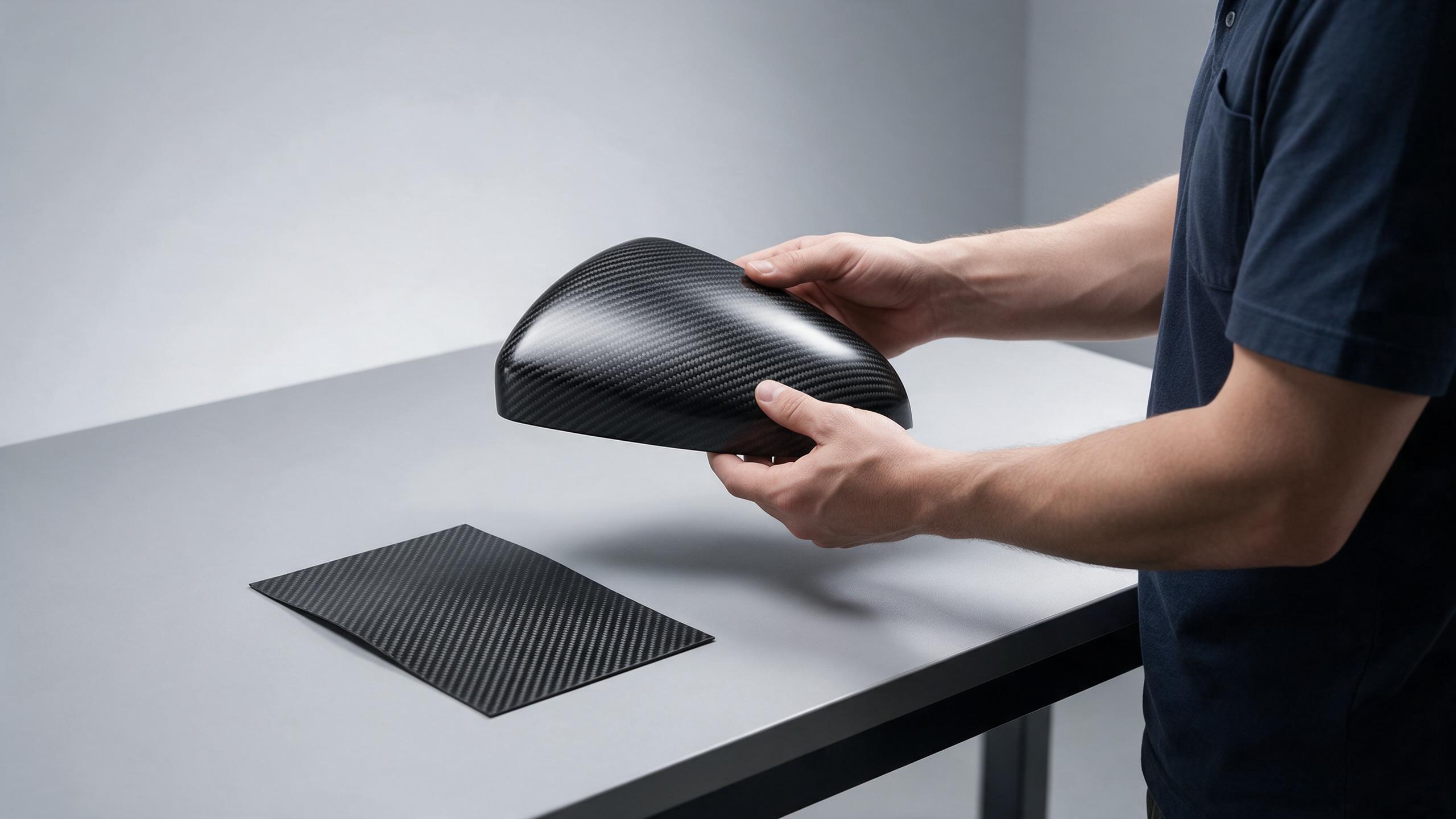
Set up a repeatable visual inspection
Unpack on a clean, padded surface and retain the carton labels. Use clean gloves and follow the supplier's handling instructions. Inspect the sample and shipment at the same orientation, viewing distance and light angle. Use diffuse lighting for an overall view and a second angled light to reveal surface irregularities. Avoid treating glare, reflections or protective film as defects; remove film only if the agreed inspection procedure permits it.
- Identify the lot. Match the SKU, part position, quantity, finish and lot or carton identifier to the order. Keep pairs together.
- Establish the axis. Place the approved sample and the delivered part in the same orientation. Use the agreed centerline or edge, rather than the edge of a curved reflection, as the reference.
- Follow the pattern. Trace several visible diagonal lines across the main face. Compare their direction, spacing and continuity with the sample, starting at the most visible zone.
- Move around contours. Inspect curves, corners, holes and transitions from more than one angle. Note where the weave turns, bunches, separates or changes direction.
- Compare the set. Place corresponding left and right parts in their installed orientation. Check the agreed mirror relationship and whether adjacent pieces form a visually consistent set.
On a curved surface the cloth can change direction as it conforms to the shape. A bend is not automatically a defect. What matters is whether each designated zone matches the approved sample and any documented allowance. A pronounced local kink on a flat, prominent face may be more significant to a buyer than a gradual change near a concealed return.
Separate weave variation from finish issues
When reviewing Auto Carbon Fiber Parts, use clear descriptions instead of a single label such as “bad weave.” A diagonal drift describes a change in visible line direction relative to the reference; a local wrinkle or bunching describes a disturbance concentrated in one area. A gap or overlap between visible tows may affect the appearance differently from a mismatch at a seam. Mark the location and compare it with the approved limit or sample.
Also note cloudiness, pinholes, scratches, uneven gloss or exposed-looking areas, but do not guess their cause from appearance alone. A mark may be in the coating, or it may involve the material beneath it. Ask the supplier to assess uncertain areas against the agreed cosmetic criteria and, where appropriate, use a qualified inspection method. Do not sand, polish or otherwise alter suspect parts before the supplier has reviewed them; alteration can remove useful evidence.
Keep appearance and fit separate in the record. A pleasing surface does not confirm mounting position, dimensions, bonding or performance. For Wholesale Auto Carbon Fiber Parts, verify the vehicle application, mounting points and installation instructions through the order documents and a separate fit check appropriate to the component.
Make acceptance criteria measurable before the shipment
There is no universal visual angle or defect count that applies to every shape and every buyer. Agree a written specification with the supplier: reference axis, zones, viewing distance, lighting, permitted direction and any agreed tolerance or sample photographs. Where an angle is specified, describe how it will be measured on the actual inspection area and what tool will be used. On complex curves, identify local reference points rather than applying one flat-plane measurement to the entire surface.
Define how many pieces will be inspected, how they will be chosen from cartons, and what happens if an issue is found. A sampling plan is a commercial agreement, not proof that every uninspected item is acceptable. If the order has no agreed sampling or acceptance rules, hold the disputed lot and ask the supplier and buyer to settle the criteria rather than inventing a tolerance after delivery.
Document a hold or acceptance decision
For each suspect item, record the order and lot, SKU, side, quantity affected, inspection date, observer and the designated zone. Photograph the full part in its installed orientation, then take a close view with a scale and reference line visible. Capture the approved sample in comparable lighting. Describe the observation and its location without declaring a manufacturing cause.
Label and segregate questionable pieces without mixing them back into accepted stock. Send the evidence and the proposed disposition to the supplier: accept by written agreement, inspect more pieces, request replacement, or arrange another agreed remedy. Keep any authorization with the lot record. If damage or a possible structural issue is visible, do not infer that the part is safe from its surface appearance; hold it for a qualified assessment.
A practical receiving checklist
- Approved sample and order revision available for the exact finish and part family.
- Reference axis, visible zones and paired-part direction agreed in writing.
- Lighting, viewing distance, measurement method and acceptance limits documented.
- Pattern inspected across flat areas, curves, transitions and corresponding pairs.
- Surface marks recorded separately from weave alignment and fit concerns.
- Lot identification, photographs, sampling decision and supplier response retained.
Use this sequence for 3K Twill Weave Carbon Car Components and other visible woven finishes, adjusting it to the actual specification. The goal is a repeatable decision on Auto Carbon Fiber Parts: accept what meets the agreed criteria, hold what does not, and resolve uncertainty before the goods move into saleable stock.
 Hot News




