
 EN

How Does Virgin ABS Base Construction Prevent a Car Armrest Box from Wobbling Under Elbow Pressure?
A Car Armrest Box can look substantial in a catalog and still feel unsettled once a driver rests an elbow on it. For a wholesaler or buyer, that distinction matters: storage, padding, and trim are visible, while the load path below the lid is what determines whether an installed unit feels composed. A virgin-ABS base may contribute to a more consistent foundation, but it is only one part of the stability decision.
From a bulk-purchase viewpoint, a Car Armrest Box should be evaluated as an assembly. The pad transfers a downward and sometimes sideways load into the upper shell, the base, its contact points, and finally the vehicle-side mounting point. If any point in that chain is loose, narrow, mismatched, or poorly supported, the user can feel movement even when the plastic itself appears rigid.
Why elbow pressure exposes movement in a Car Armrest Box
Elbow pressure is not a laboratory test; it is an off-center, repeated input. A driver may lean while steering, reach for a control, or rest weight near one edge of the lid. That creates a turning effect as well as a vertical load. A Car Armrest Box with a small or uneven footprint can rock around its contact points. A loose bracket, worn fastener, or gap between the base and console can make that motion easier to feel.
This is why storage volume alone says little about stability. The useful question is where force travels after the lid is pressed. A stable Car Armrest Box needs the base to spread that force across a suitable contact area and the mounting arrangement to keep the base located rather than allowing it to shift.
What virgin ABS can contribute to the base
ABS is widely used for automotive interior components because appropriate grades can balance stiffness, toughness, impact resistance, and surface finish. In a Car Armrest Box, a virgin-ABS base may offer more predictable material behavior than a base made from an unknown or inconsistent recycled blend. That predictability can help a manufacturer control molded geometry, wall continuity, and the shape of locating features.
It is important not to turn that into a blanket claim. “Virgin” identifies feedstock status, not a complete specification. Grade selection, wall thickness, rib layout, molding conditions, cooling, and attachment design all affect how a Car Armrest Box behaves. Without a drawing, material grade, and test method, a buyer cannot infer a particular load rating or state that any Car Armrest Box will remain motionless under every use condition.
The practical advantage is design consistency. When the base retains its intended shape and supports its attachment points evenly, it can reduce one source of unwanted movement. The result still depends on whether the Car Armrest Box matches the vehicle console and whether the mounting hardware is installed correctly.
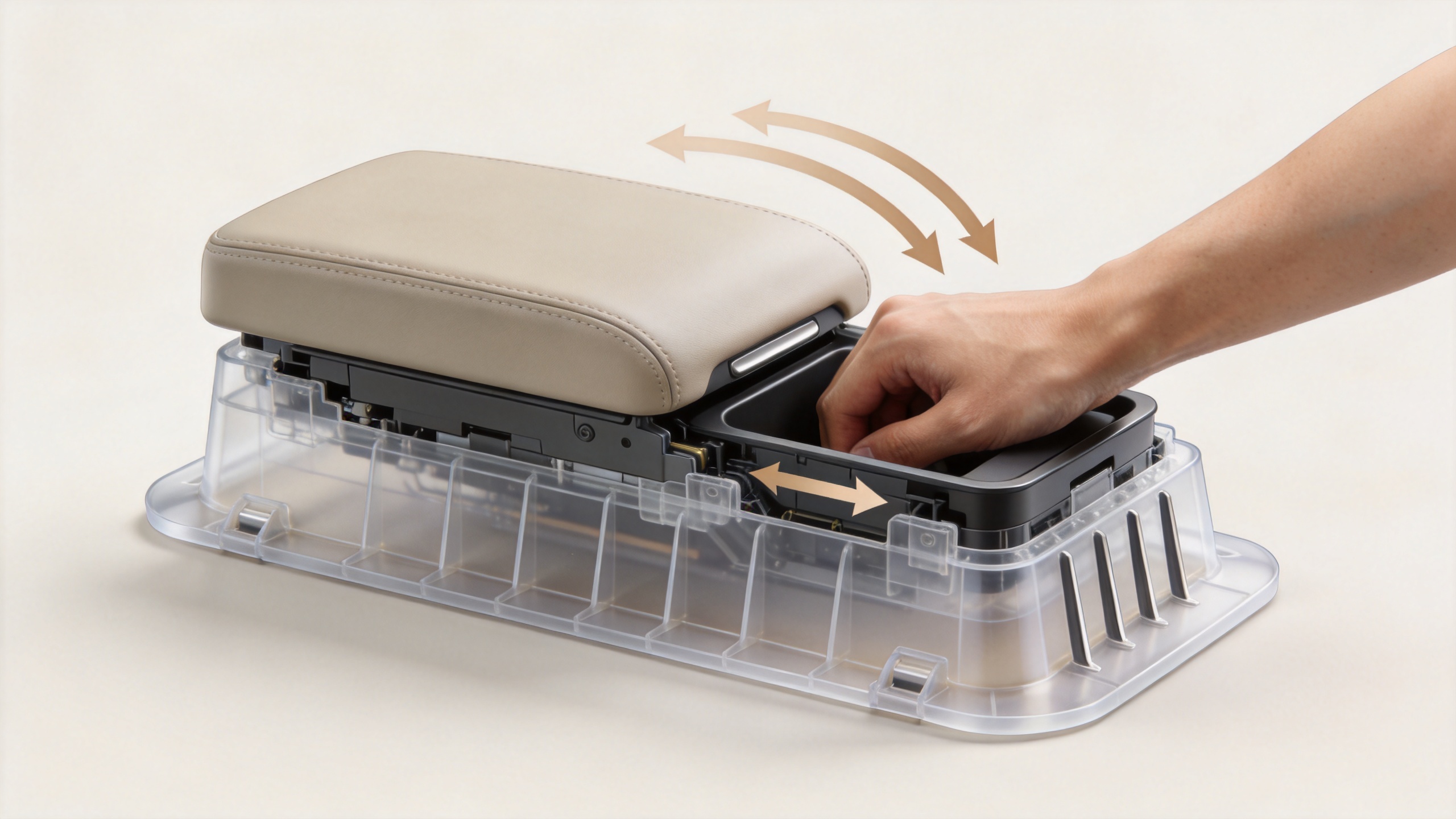
Four base-design details that matter as much as the resin
1. A broad, properly matched footprint
A Car Armrest Box gains stability when its lower surface follows the console area it is meant to contact. Broad, even contact can limit rocking. Conversely, a base resting on two high spots or bridging a recess can flex or pivot under an elbow. Ask for underside photos, a dimensional drawing, and the intended vehicle/console application before treating a listing as vehicle-specific.
2. Ribs and load paths near attachment zones
Ribs can add shape control without making every wall excessively thick. For a Car Armrest Box, their position matters more than their presence in a generic photo. Useful questions include whether support reaches the mounting zones, whether the base has unsupported spans, and whether screw bosses or clips are backed by surrounding structure. These are design-review questions, not evidence of a performance claim unless the supplier provides supporting data.
3. Positive location before fastener tightening
Fasteners primarily clamp; locating tabs, contours, brackets, or cup-holder interfaces help resist side-to-side shifting. A Car Armrest Box that relies only on a single central screw may react differently from one that also has shaped locating features. The exact solution depends on the vehicle mounting geometry, so a buyer should compare the mounting scheme against the actual console rather than assume that a familiar-looking base fits.
4. Controlled tolerances at the contact area
A small gap at the console contact surface can become noticeable at the top pad because leverage amplifies movement. A Car Armrest Box can therefore feel loose even if its base material is sound. For a Virgin ABS Base Car Armrest Box, request the fitment range, the surfaces used for location, and any vehicle-year or trim limitations. Pictures help identify shape, but they do not replace those checks.
How to evaluate a Heavy-Duty No-Wobble Auto Armrest claim
The phrase Heavy-Duty No-Wobble Auto Armrest should start a verification discussion, not end one. “Heavy-duty” has no useful purchasing meaning until it is tied to an ABS grade, base geometry, attachment method, vehicle application, or defined test procedure. “No-wobble” should likewise be treated as a target condition tied to a specific installed configuration, not a universal promise.
For a Car Armrest Box sourcing review, ask the supplier to state what is known and what remains to be confirmed:
- Which vehicle, year range, and console layout is the Car Armrest Box intended to fit?
- What material grade, base thickness range, or reinforcement details can be documented?
- How does the base locate on the console before the fasteners or straps are secured?
- Which mounting parts are included, and what torque or installation instructions apply?
- Has the installed Car Armrest Box been checked for vertical movement and side-to-side shift under a defined load?
- Can a sample, dimensional drawing, or installation video be reviewed before a bulk order?
A practical inspection sequence for a Car Armrest Box
- Confirm the application. Start with the vehicle, year, trim, console shape, and cup-holder or mounting position. A model name alone may not describe every interior variation.
- Inspect the underside. Look for continuous contact areas, locating features, and reinforcement near the attachment points of the Car Armrest Box.
- Check the installed gap. Before loading the pad, confirm that the base sits as intended and that included spacers or brackets are used only where specified.
- Apply controlled hand pressure. Press near the center and then toward each edge while watching the base-to-console contact surface. Record where movement begins rather than relying on a general impression.
- Recheck after use. A Car Armrest Box that shifts after repeated opening, closing, or road use may need its fasteners, fitment, or console contact points reviewed.
What buyers should conclude
Virgin ABS can be a sensible material choice for the base of a Car Armrest Box because a controlled material input can support consistent molded geometry. It does not, by itself, establish stability. The decisive combination is a suitable base footprint, reinforcement around the load path, positive location, secure attachment, and verified compatibility with the vehicle console.
For wholesale planning, turn those points into a repeatable specification checklist. Collect the vehicle application, base drawing, underside images, installation hardware list, and sample-review notes for each Car Armrest Box SKU. That approach gives purchasing teams a clearer basis for comparing options than an isolated material label or an unqualified “no-wobble” statement.
FAQs
Does a virgin-ABS base make every Car Armrest Box stable?
No. It may support consistent molded geometry, but the installed stability of a Car Armrest Box also depends on footprint, reinforcement, mounting, console fitment, and installation condition.
What should be checked before ordering a Car Armrest Box in bulk?
Confirm vehicle and console compatibility, base dimensions, locating features, included mounting hardware, and whether a sample can be installed and inspected on the intended application.
Why can an armrest move even when the plastic feels rigid?
Movement can originate at the base-to-console contact surface, mounting hardware, unsupported spans, or a mismatch between the Car Armrest Box and the vehicle interior. Material stiffness is only one part of the assembly.

 Hot News




