
 EN

How Do Bulk Bagged vs. Retail Blister Fastener Clip Options Impact B2B Distribution Costs?
A fastener clip quote is not the same as the cost of putting a sellable item in a buyer's hands. A bag of loose clips may require counting, labeling and repacking; a blister pack may arrive ready for a store shelf but take more space per piece. For a distributor, the useful comparison follows the same clip from receiving through the final sale.
The comparison depends on order size, customer channel and who does the handling. Compare a Bulk Bagged Fastener Clip offer with Retail Blister Box Auto Trim Clips using the same specification and quantity first. Then add the costs that each quote leaves to your team. Neither format is automatically cheaper.
Start with the same fastener clip and selling unit
Packaging comparisons only work when the parts are comparable. Confirm the fastener clip design, material, head and stem dimensions, hole size, panel thickness and intended installation position with the supplier. Similar-looking clips are not necessarily interchangeable. Request drawings or samples where available, and confirm the application before placing a volume order.
Next, define the unit being priced. Is the offer for one fastener clip, a bag, a retail pack, an inner box or a shipping carton? Record pieces per bag and per retail pack, packs per carton, minimum order quantity, and the number of usable pieces expected. Ask whether labels, instructions, barcodes and packing labor are included. A pack with ten pieces should not be compared directly with a bag of one hundred without normalizing both to the same quantity.
Where bulk bags can change distribution costs
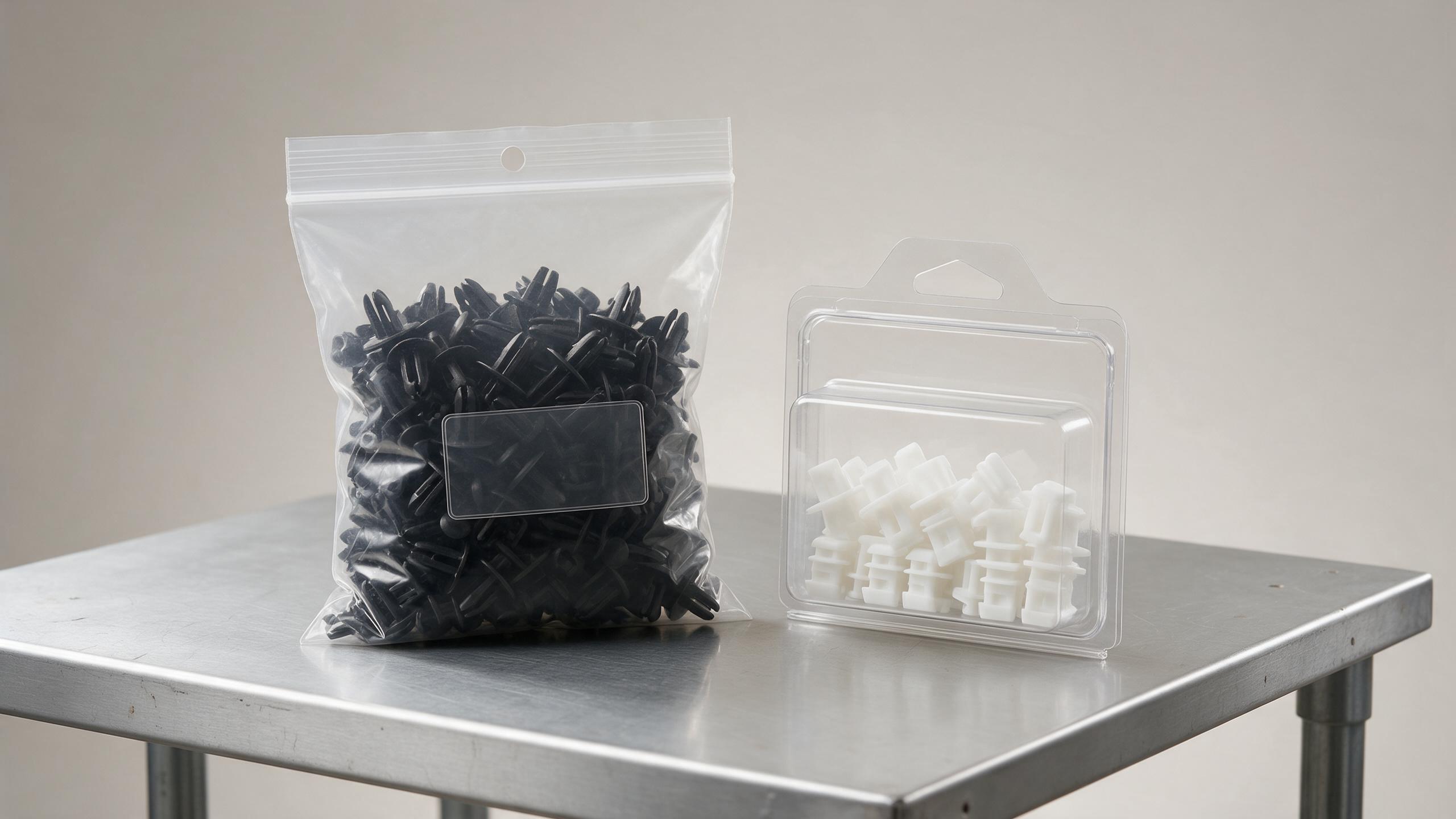
A Bulk Bagged Fastener Clip order can make sense when a repair shop consumes pieces from a bin or a distributor already has a counting and packing process. Fewer individual retail packages may reduce the amount of presentation material purchased. The actual price difference, however, must come from comparable supplier quotes, not an assumed percentage.
Bulk handling creates its own tasks. Staff may need to count clips, separate similar fastener clip sizes, print labels, seal bags and inspect finished packs. If the customer needs shelf-ready units, include the packaging materials, labor time and any rejected or missing pieces in the calculation. Account for storage space and the extra movement between receiving, packing and dispatch as well.
Check how each bag is identified before it enters stock. A part number, quantity and batch reference agreed with the supplier can make stock checks more practical. If multiple designs look alike, ask for separate, clearly marked bags rather than assuming a mixed shipment can be sorted without additional work.
What retail blister packaging adds or removes
Retail Blister Box Auto Trim Clips may suit a channel selling individual packs through a counter, a physical shop or an online listing. A visible pack can present a quantity and part description to the buyer. If the supplier actually provides a finished, correctly labeled pack, the distributor may avoid some local repacking work. Confirm those services in the quote; a blister format alone does not establish that a pack is ready for a particular retailer.
The trade-off is the cost of the pack, artwork, label changes and potentially more space per fastener clip. A sealed pack also fixes the selling quantity until someone opens and repacks it. Compare the impact on shelf space, warehouse locations and the number of packs shipped in an outer carton. Check whether damaged packaging can still be sold under the customer's rules.
Ask each retail account which identifiers and information it needs. GS1 describes trade-item identifiers for packaging levels such as individual consumer units and cases. That does not mean every buyer has the same barcode requirement: verify the applicable identifiers, artwork and carton labels before ordering. Incorrect data can add relabeling or rejection costs to a fastener clip shipment.
Build a comparable landed-and-handled cost
Use the same destination, quantity, currency, delivery terms and time period for both quotes. Use this calculation as a starting point:
Cost per usable selling pack = (purchase price + inbound freight and applicable duties + receiving + repacking and labels + storage and handling + expected adjustments) ÷ usable selling packs.
Use actual quotations and local records for every term. Avoid counting a service twice: if the supplier's quoted price already includes labeling, do not add that same label cost again. Separate uncertain figures from confirmed charges and run a range when your own labor time or waste rate is unknown.
A clearly hypothetical comparison
Suppose an order provides 1,000 equivalent clips, sold in packs of ten. For illustration only, assume bulk purchase and inbound charges total $120, and local counting, bags and labels add $50. If all pieces are usable, 100 packs cost $1.70 each. Suppose a retail-ready alternative costs $190 including inbound charges, with $10 of receiving work: 100 packs cost $2.00 each. These numbers are not market prices or a supplier offer.
Change the assumptions and the result can reverse. If the bulk packing operation costs $90 instead of $50, the bulk total becomes $210, or $2.10 per pack. Compare any loss or damaged goods on both sides using your own records, and avoid assuming a rate without evidence. The example excludes other costs unless explicitly included; add duties, storage and downstream delivery as applicable.
Measure the shipping carton, not just the clip
Ask for packed carton dimensions, gross weight, clip count and pallet configuration for each fastener clip option. Retail packaging can change how many units fit in a carton, so compare freight per usable selling pack rather than freight per carton alone.
For parcel services that apply dimensional weight, the quoted calculation may use length multiplied by width and height, divided by a specified factor. The shipping provider's measurement, rounding and billing rules matter; request an actual rate for each packed configuration. Do not apply one parcel formula to every freight mode or destination.
Choose the format by customer and stock workflow
- Workshop or high-volume bin use: Compare bulk bags against the cost of counting, stock identification and replenishment. Confirm whether customers consume loose fastener clip pieces or need smaller packs.
- Retail counter or online resale: Price ready-to-sell packs against local repacking. Check the item description, pack quantity and any required barcode before committing to printed stock.
- Mixed channels: Consider separate order lines for bulk and retail packs only if the supplier confirms both formats, order quantities and lead times. Track each selling unit separately in inventory.
For slow-moving sizes, a large stock commitment can tie up space and cash; for frequent orders, repeated handling may matter more. Use your own sales history and reorder pattern to test both cases rather than relying on a universal break-even volume.
Questions to settle before the purchase order
- Are the fastener clip dimensions and intended installation position confirmed with drawings or samples?
- How many usable pieces, bags and selling packs are included in each quote?
- Who supplies and pays for artwork, barcodes, labels, instructions and repacking?
- What are the outer carton dimensions, weight, quantity and delivery terms?
- What are the minimum quantities, lead times and agreed process for damaged or incorrectly labeled packs?
Put unresolved points to the supplier before comparing the final numbers. A fastener clip decision becomes clearer when purchase price, presentation work and shipping are measured against the same customer-ready unit. The right mix is the one your team can verify, handle and sell within its actual workflow.
 Hot News




