
 EN
EN
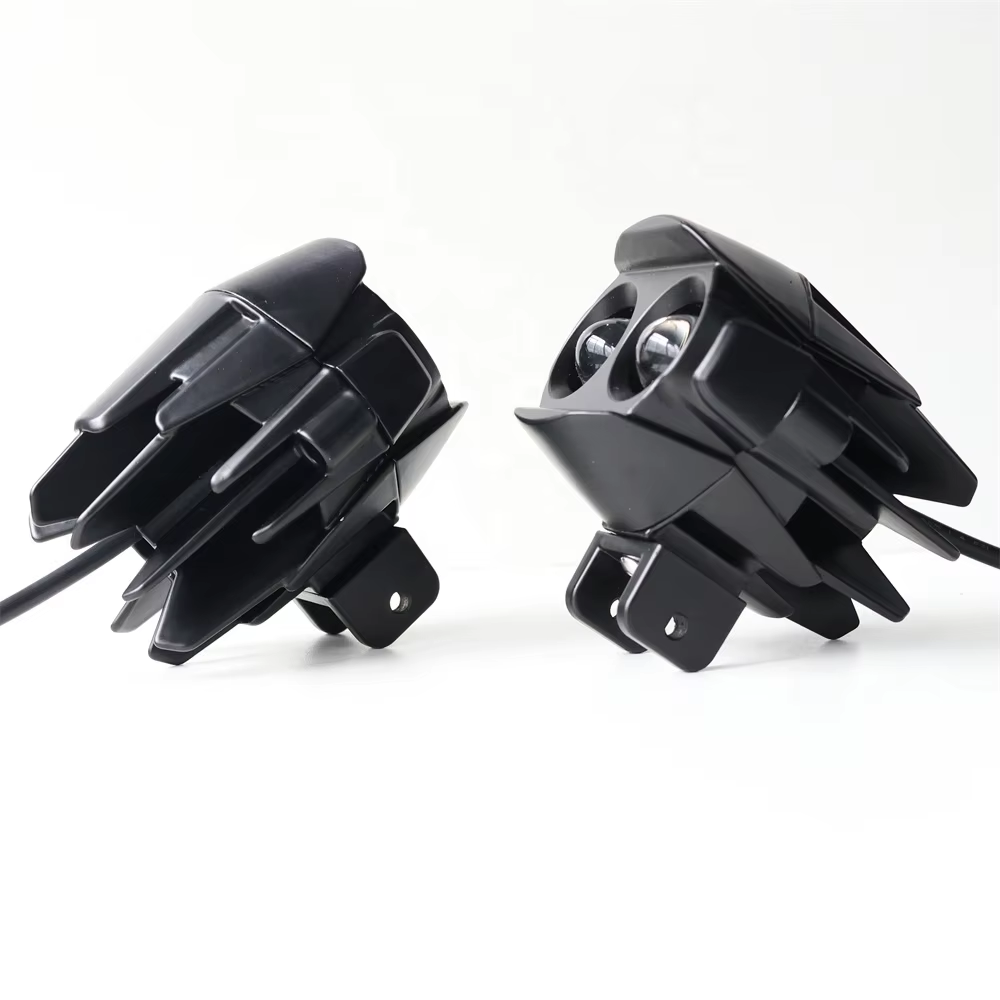
How Motorcycle Auxiliary Fog Lights Enhance Low-Visibility Safety
Beam geometry and spectral design: Why wide, low-mounted amber LED patterns reduce backscatter in fog, rain, and dust
When fog, rain, or dust hangs in the air, standard headlights create a blinding wall of reflected light—known as backscatter. Motorcycle auxiliary fog lights counter this with purpose-built optics: mounted low (typically below the headlight) and engineered to project a wide, flat wedge of light that stays close to the road surface. This geometry ensures the beam passes beneath the densest layer of airborne particles, minimizing reflection into the rider’s eyes. Amber LEDs further reduce glare because their longer wavelength scatters less in fine mist than blue-rich white light. The result is crisp, low-contrast illumination of lane markings, pavement texture, and edge lines—even when visibility drops to tens of meters—without sacrificing peripheral awareness.
Filling the 'visibility gap': Illuminating critical ground-level hazards (potholes, debris, animals) missed by standard headlight beams
Standard headlights prioritize long-range projection, leaving a dangerous blind spot directly ahead of the front wheel—the “visibility gap.” Potholes, gravel, branches, and wildlife often remain undetected until reaction time is gone. Auxiliary fog lights eliminate this gap with a broad, low-angle beam that illuminates not just the immediate path but also shoulders and verges, where hazards commonly appear. Their low mounting position also keeps the beam beneath oncoming vehicles’ hoods and avoids obstruction by the rider’s body or gear. When properly aimed, these lights deliver up to two seconds of additional reaction time—the margin that separates controlled avoidance from collision—transforming low-visibility riding from reactive to deliberate.
The Real-World Safety Case for Motorcycle Auxiliary Fog Lights
National data reveals a counterintuitive reality: while many riders associate crash risk with night riding, a significant share of fatal motorcycle crashes occur in daylight—driven not by darkness, but by low contrast. Dawn, dusk, and precipitation degrade visual acuity for both riders and other drivers, making motorcycles harder to see and hazards harder to detect.
NHTSA and IIHS data: Linking reduced-visibility conditions (dawn, dusk, precipitation) to 32% of fatal motorcycle crashes despite daylight prevalence
Analyses from the National Highway Traffic Safety Administration (NHTSA) and the Insurance Institute for Highway Safety (IIHS) show that reduced-visibility conditions—including twilight and precipitation—account for 32% of fatal motorcycle crashes. Crucially, this occurs despite most riding taking place in full daylight. The underlying issue is contrast loss: motorcycles visually recede into backgrounds during low-light transitions or in wet conditions, diminishing detection by car drivers and impairing the rider’s ability to identify ground-level threats. Auxiliary fog lights with wide, low-mounted, amber-tuned beams address both sides of this problem—enhancing the rider’s forward view while increasing the bike’s conspicuity to others. In doing so, they target the root cause behind nearly one in three fatal crashes.
Tiypeor Motorcycle Auxiliary Fog Lights: Performance, Compliance, and Differentiation
Optical validation: 41% lower backscatter vs. generic pods in SAE J2519-compliant fog simulations (0.5 km visibility)
In SAE J2519-compliant fog simulations at 0.5 km visibility, Tiypeor motorcycle auxiliary fog lights demonstrated 41% lower backscatter than typical aftermarket LED pods. This performance stems from two integrated design choices: a precisely calibrated wide/low beam pattern that minimizes particle reflection, and amber LED emitters optimized to reduce short-wavelength scatter. For riders encountering sudden fog banks or rain squalls, the outcome is measurable—cleaner road definition and significantly reduced visual fatigue.
Regulatory alignment: Meeting DOT/ECE photometric thresholds where >85% of aftermarket units fail
Performance without compliance is unsafe—and potentially illegal. Industry audits indicate over 85% of aftermarket fog lights fail to meet basic DOT (U.S. Department of Transportation) or ECE (Economic Commission for Europe) photometric standards. Tiypeor units are engineered to satisfy these requirements, delivering precise beam cutoff, controlled glare suppression, and consistent luminous intensity. That means no blinding oncoming traffic, no compromised coverage in poor weather, and no risk of citation. Choosing certified lights isn’t just about legality—it’s about trusting your vision when it matters most.
Correct Installation and Usage: Maximizing Safety Benefits of Motorcycle Auxiliary Fog Lights
Mount auxiliary fog lights low on the motorcycle—ideally below the headlight—to ensure the beam projects a wide, flat pattern onto the pavement, illuminating edges and hazards without creating glare. Aim them carefully: too high risks dazzling others; too low sacrifices forward reach. Once installed, integrate them cleanly into the bike’s electrical system and verify alignment using a level surface and reference marks.
Use discipline matters as much as placement. Activate fog lights only when visibility falls below 100 meters due to fog, heavy rain, snow, or dust—and switch them off immediately when conditions improve. Using them in clear weather violates DOT/ECE photometric regulations in most jurisdictions and undermines their safety benefit by reducing driver trust in the signal. When installed and used correctly, auxiliary fog lights don’t just add light—they restore confidence, control, and critical decision time in the conditions where riders need it most.
FAQ
Why should I use amber LEDs for fog lights?
Amber LEDs scatter less light in fine mist or fog compared to blue-rich white light, improving visibility and reducing glare for both the rider and other drivers.
How do auxiliary fog lights help with low-visibility conditions?
Auxiliary fog lights are designed to project a low, wide beam that cuts below the densest layers of fog, rain, or dust, minimizing reflection and enhancing ground-level hazard detection.
Do auxiliary fog lights meet legal standards?
Certain brands, like Tiypeor, are certified to meet DOT and ECE photometric standards, reducing glare and ensuring safety and legality on the road.
Where should fog lights be mounted on a motorcycle?
Fog lights should be mounted low on the motorcycle, ideally below the headlight, to project a flat beam onto the road without creating glare.
Can I use fog lights in clear weather?
No, fog lights are intended for use only in reduced-visibility conditions (e.g., fog, heavy rain, snow). Using them in clear weather could violate regulations and diminish their intended safety benefit.
