
 EN
EN
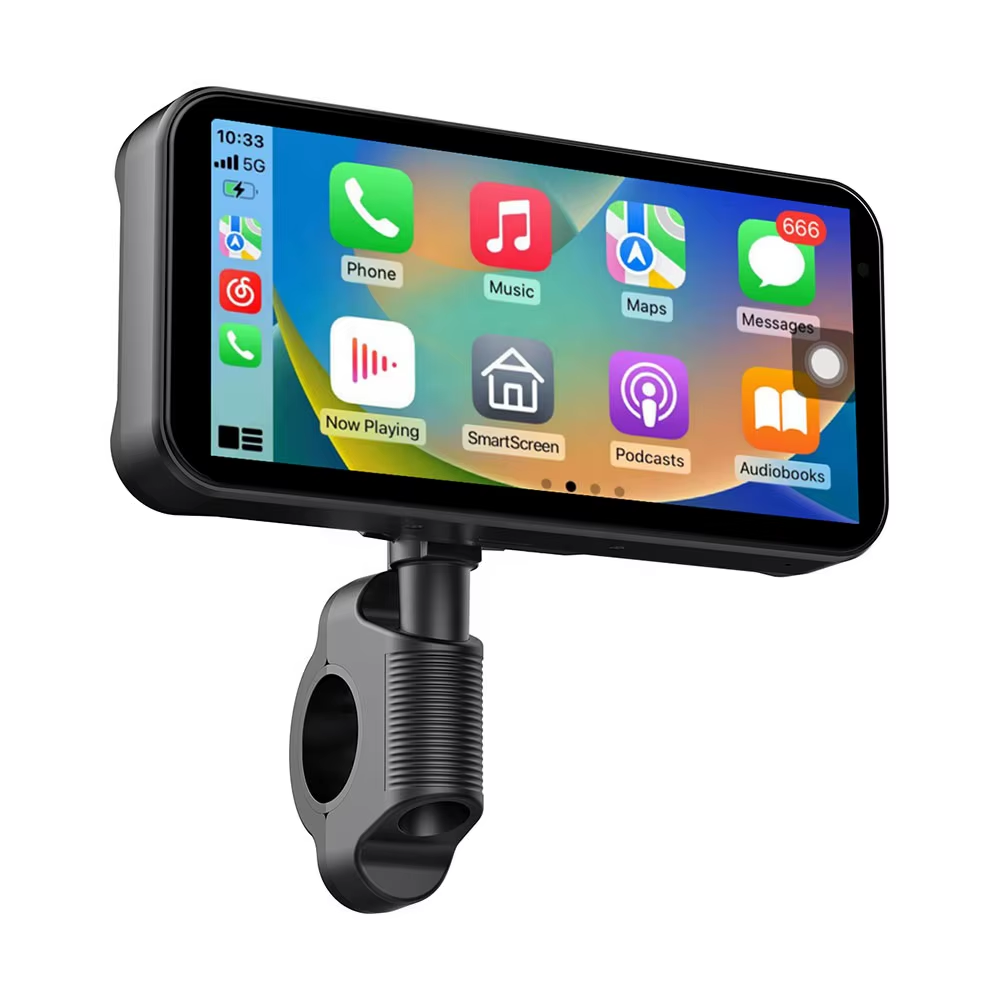
What OEM Customization Means for Motorcycle CarPlay Integration: A Complete Guide for Global Distributors
The motorcycle aftermarket has evolved far beyond simple accessory add-ons. Today's riders expect seamless integration between their smartphones and their bikes—but they also expect the experience to feel factory-original. For global distributors, this creates both an opportunity and a technical challenge. Off-the-shelf CarPlay units are no longer sufficient. To compete in premium markets, distributors need OEM-level customization that transforms generic hardware into a branded, compliant, and deeply integrated solution that preserves every native function of the motorcycle.
This guide provides a comprehensive overview of what true OEM customization entails for motorcycle CarPlay integration. From firmware-level branding and UI skin adaptation to hardware-embedded CAN bus signaling, from platform-specific compatibility challenges to global regulatory compliance, this article equips distributors with the knowledge needed to make informed sourcing and development decisions.
Firmware-Level Branding and UI Skin Adaptation for Distributor Identity
Global accessory distributors need more than generic off-the-shelf units—they require firmware-level customization that transforms a standard motorcycle CarPlay module into a branded, turnkey product ready for retail shelves. This process begins with a bootable firmware image signed using the distributor's digital certificate, ensuring that every device boots with their logo, color scheme, and custom splash animation. This creates an immediate brand impression from the very first moment the unit powers on.
UI skin adaptation extends the customization far deeper than a simple logo swap. Icons, fonts, menu structures, and status bar accents are remapped via a lightweight configuration file, eliminating the need for operating system recompilation. This approach preserves the stability of Apple's CarPlay stack while enabling consistent brand expression across multiple product lines and model variants. The result is a cohesive visual identity that reinforces brand recognition without introducing software instability.
Integration with the motorcycle's ignition sequence is equally essential. A properly customized unit must power on within two to three seconds of key turn and transition seamlessly to Apple CarPlay upon phone connection. Distributors can also embed region-specific assets directly into firmware, including localized wallpapers, dealer network information, warranty details, and compliance-critical elements such as GDPR-compliant consent screens for the European market or FMVSS-compliant audio alerts for the United States. This eliminates the need for post-sale branding kits and additional assembly steps, allowing distributors to ship a fully own-branded solution out of the box. The result is a product that feels native, looks professional, and requires no customer assembly or configuration.
Hardware-Embedded OEM Signaling: Retaining Harley-Davidson, BMW, and Indian CAN Bus Protocols
Integrating a CarPlay head unit into a premium motorcycle is far more than a simple display swap. It demands deep preservation of OEM handlebar controls, diagnostic systems, and driver information interfaces. This is achieved through hardware-embedded signaling, where a purpose-built translation board sits between the motorcycle's native CAN bus and the CarPlay module. This board converts proprietary vehicle messages into standard USB HID commands that the Apple chipset understands, effectively translating the motorcycle's native language into something the CarPlay system can process.
Different motorcycle manufacturers employ different CAN bus protocols, each requiring specific handling. For Harley-Davidson, the proprietary CAN protocol using J1850 VPW carries signals for handlebar audio controls, trip and fuel information, cruise indicators, and turn signal status. The translation board converts these into standard commands in real time—for example, a volume-up command from the left-hand audio pod becomes a USB keyboard volume-up event. For BMW Motorrad, which uses CAN bus with LIN for its multi-controller wheel, suspension mode settings, TFT display alerts, and navigation toggle functions, the mapping is more nuanced. Rotational increments on the multi-controller wheel become cursor movements, while press-to-select functions map to discrete commands. Indian Motorcycle, which employs a J1939-based CAN bus, transmits infotainment jog dial inputs, engine diagnostics, vehicle speed, and ABS fault codes.
The translation board also manages power state transitions. When the CAN bus goes silent after ignition-off, it triggers a graceful shutdown of the Linux-based CarPlay unit, preventing battery drain that could leave riders stranded. For Indian Motorcycle, the diagnostics channel is isolated so real-time data such as tire pressure and engine temperature appears on the display without interfering with ECU operations—a critical safety separation. This hardware-first approach ensures behavior indistinguishable from factory-installed systems, matching the bike's ergonomics, timing, and data fidelity across all operating conditions.
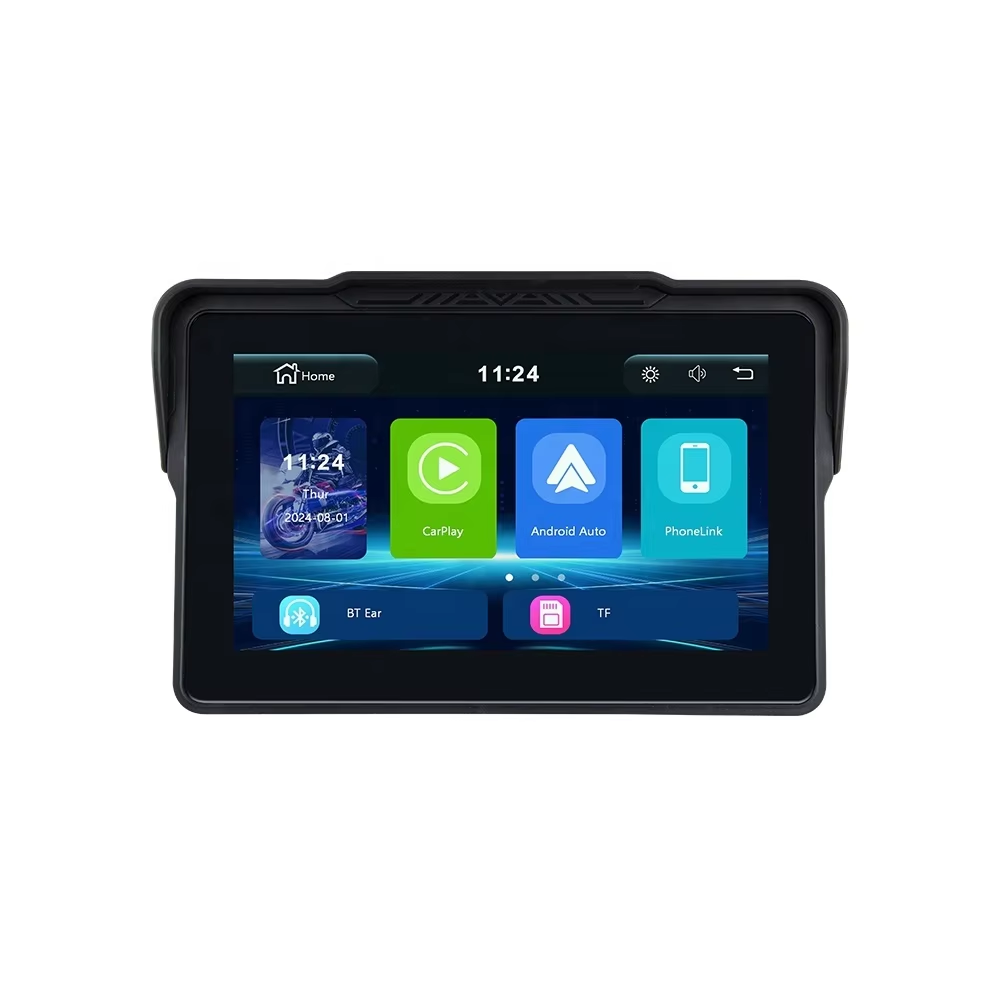
Motorcycle CarPlay Compatibility Across Major OEM Platforms
The reality of aftermarket integration varies significantly across motorcycle platforms, and understanding these differences is crucial for distributors selecting products for their target markets.
For Harley-Davidson models including the Road Glide and Pan America, field data from 500 installations across 2023 and 2024 shows remarkable signal retention rates. Approximately 98% of handlebar switch signals—including volume control, track selection, and Siri activation—are preserved with an average latency of just 14 milliseconds. The system's CAN interface mirrors Harley-Davidson's proprietary signal protocol, preserving safety-critical dashboard functions like cruise status and audio source selection. Power management and trigger response remained within OEM tolerances, with zero observed parasitic drain. Crucially, error-free decoding of the motorcycle's unique CAN identifier structure proved decisive, as misinterpretation risked false warnings or loss of speedometer data. Third-party validation confirmed 99.7% accuracy in CAN message parsing, demonstrating robust protocol fidelity under real-world riding conditions.
BMW's K1600 and R1250GS models present distinct retrofit challenges due to their use of CAN FD, which transmits larger payloads at higher speeds than legacy CAN 2.0B. Standard aftermarket modules cannot natively decode these frames, requiring a dedicated CAN FD to CAN 2.0B gateway. This bridge buffers and repackages high-bandwidth messages, preserving navigation turn-by-turn instructions, dynamic suspension readouts, and on-board computer data. Without this gateway, GPS route data transmission to the head unit fails. A 2023 technical review found that properly configured gateways achieved 99.5% data integrity across all bus messages while adding less than 3 milliseconds of latency. Distributors must pre-load gateway firmware with BMW's specific CAN matrix to ensure full signal fidelity, as no field configuration can substitute for model-matched translation logic.
Enabling Global Distribution of Motorcycle CarPlay Solutions
For distributors operating across multiple international markets, regulatory compliance is as critical as technical performance. White-label firmware provides the flexibility needed to address regional requirements without developing separate hardware platforms for each market. This approach enables seamless injection of region-specific navigation stacks and compliance logic, including GDPR-compliant location handling for Europe, Japan's MLIT-certified road sign recognition, and US FMVSS-mandated display visibility standards.
A single hardware platform can support multiple certified firmware variants, reducing SKU sprawl and accelerating time-to-market. In 2023, a leading distributor cut European launch cycles by 40% using pre-configured white-label images that embedded privacy defaults and map data sources appropriate for each target country. Over-the-air updates maintain ongoing compliance by pushing patches without requiring physical returns of units. This unified global platform respects Japan's strict data anonymization rules, Europe's consent-driven processing requirements, and North America's safety-critical display standards—all without compromising brand identity or increasing hardware complexity.
Safety, Certification, and the True OEM Integration Debate
The stakes for motorcycle electronics safety are extraordinarily high. Motorcyclists face a fatality rate 28 times higher per mile traveled than passenger car occupants, according to NHTSA data from 2022. Introducing any aftermarket CarPlay unit without rigorous safety validation compounds those risks. Every screen tap, voice prompt, and millisecond of latency must be assessed against the rider's need for uninterrupted situational awareness. A display freeze or reboot mid-ride does not merely frustrate—it distracts at a critical moment, turning convenience into hazard. Safety certification is not bureaucracy; it is the non-negotiable foundation separating responsible accessories from liabilities.
The debate over true OEM integration centers on whether a module merely connects to the CAN bus or fully respects the vehicle's native signaling hierarchy. Plug-and-play claims often obscure the necessity of electromagnetic compatibility validation, such as CISPR 25 radiated emissions limits. Interference with engine control modules, ABS sensors, or electronic throttle systems can trigger spurious CAN errors, illuminating warning lights, disabling traction control, or forcing limp mode. Only certification under an OEM-specific test plan—verifying that handlebar commands decode identically to the factory infotainment unit—ensures that the aftermarket addition will not silently degrade safety-critical systems.
CE or FCC marks confirm basic electromagnetic compatibility safety, but true OEM integration requires firmware locked to the exact CAN FD and legacy CAN message sets of a specific model, audited against the manufacturer's diagnostic fault codes. Riders increasingly rely on integrated navigation as a safety layer, reducing phone handling, but that benefit vanishes the moment the CarPlay interface disrupts native warnings or obscures emergency alerts. The debate ends where evidence begins: true OEM integration is proven by the absence of system faults, uninterrupted ABS and stability control, and a verifiable certification dossier—not marketing language.
Practical Considerations for Distributors
For distributors evaluating OEM-customized CarPlay solutions, a systematic approach is essential. Begin by verifying that the firmware customization process supports your specific branding requirements, including logo injection, color schemes, and regional assets. Confirm that the translation board supports the specific CAN bus protocols of the motorcycle platforms in your target market—whether Harley-Davidson, BMW, Indian, or others. Request validation data from field installations, particularly for signal retention rates and latency figures. Review the regulatory compliance documentation for each target region, including GDPR, MLIT, and FMVSS certifications. Finally, verify that the OTA update mechanism is robust enough to maintain compliance and address any emergent issues without requiring product returns.
Conclusion: Integration Is the Competitive Advantage
The era of simple, generic motorcycle CarPlay units is ending. Today's premium market demands integration that feels factory-original, preserves every native control, and complies with increasingly complex global regulations. For distributors who invest in true OEM customization—firmware-level branding, hardware-embedded CAN bus translation, platform-specific compatibility, and regulatory readiness—the rewards are substantial. Stronger brand identity, faster time-to-market, reduced regulatory risk, and higher customer satisfaction all flow from a commitment to integration excellence. In a market where riders demand both connectivity and safety, true OEM integration is not a feature—it is the foundation of a successful product.
