EN

What Makes One-Piece Molded IP67 Waterproof Motorcycle Heated Grips Safer in Heavy Rain?
Rain changes more than the temperature at the handlebar. Water reaches cable exits, switches and connectors, while a rider still needs a predictable throttle and a comfortable hold. Motorcycle Heated Grips with a sealed, one-piece molded grip body may reduce routes for moisture to reach the heating assembly. The useful word is may: safety depends on the tested construction, the rest of the electrical system and a proper installation, not on a label alone.
For a rider or a parts buyer, the practical question is not simply whether the surface is called waterproof. Ask which parts carry the rating, how the wiring is protected and whether the installed grip allows normal control of the motorcycle. These checks are especially relevant when comparing kits for frequent wet-weather use.
What does IP67 actually tell you?
IP67 describes protection against dust and temporary immersion under defined test conditions in IEC 60529. The first digit, 6, denotes a dust-tight enclosure; the second, 7, concerns temporary immersion. A commonly stated test condition for suitable enclosures is immersion up to one meter for 30 minutes. The exact test setup depends on the enclosure and the standard. It is a laboratory classification, not a promise of an unlimited time underwater.
For IP67 Waterproof Motorcycle Heated Grips, that distinction matters. A rating for the molded grip body does not automatically cover the controller, plug, splice or fuse holder. Nor does an immersion rating alone establish resistance to a pressure washer or every rain direction and riding condition. Request the test report or a clear supplier declaration identifying the tested assembly, its configuration and the applicable standard. If a cable was connected during testing, ask how that connection was sealed.
Why can a one-piece molded body help?
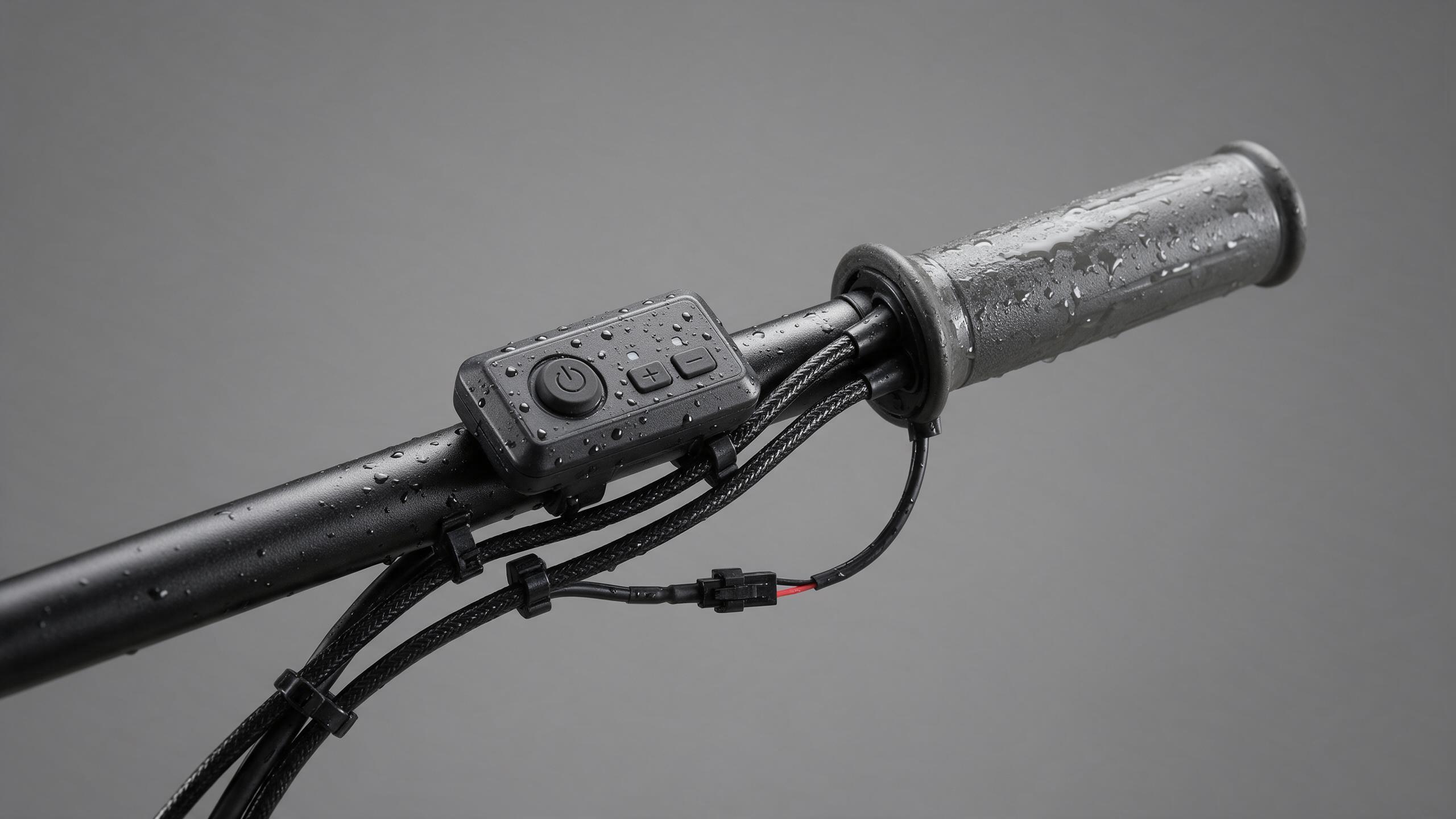
A molded outer body can enclose heating elements within a continuous layer rather than relying on a separate outer sleeve at every point. When the design and manufacturing are sound, fewer exposed joints in the grip body can mean fewer potential paths for water ingress. That is a construction principle, not proof that any particular pair of Motorcycle Heated Grips is sealed or more durable than another design.
Look closely at the transition where the wire exits the grip. Even a continuous outer surface has an electrical entry or exit that needs appropriate sealing and strain relief. Repeated steering and throttle movement must not tug at that point. Check for cuts, gaps, loose material or crushed wiring during installation, and replace damaged components according to the maker's instructions rather than covering an unknown fault with tape.
One-Piece Molded Rainproof Bike Grips also need a surface that remains usable with the rider's gloves. A sealed heating element does not determine the friction of a wet grip. Texture, glove material, grip diameter and hand position all affect feel; assess them on a stationary motorcycle before a ride. Heated grips can improve hand comfort, but they do not replace weather-appropriate gloves or give assurance against loss of traction.
Follow the water path beyond the grip
When comparing Motorcycle Heated Grips, trace the circuit from each grip to the controller, power supply and ground. A sealed grip attached to an exposed connector can still leave a vulnerable point. Water may travel along a poorly routed cable toward a connection, while road spray can reach components that are lower or more exposed than the handlebar.
- Connectors: Confirm whether each exposed connector is specified for the intended environment and installed in the orientation described by the manufacturer. Keep sealing faces clean and fully engaged.
- Controller: Check its own ingress rating and mounting instructions. A rating on the grip should not be assumed to apply to the control unit.
- Power and fuse: Use the kit and motorcycle instructions for supply, fuse type and location. If the wiring or available electrical capacity is uncertain, consult a qualified motorcycle technician.
- Cable routing: Leave enough movement for steering and the throttle, avoid abrasive edges and hot or moving parts, and secure the harness without pinching it.
The same checks apply to any Motorcycle Heated Grips installation, whether or not the housing has an IP marking. If a supplier cannot identify the rating of an exposed part, treat it as unverified rather than assuming the entire kit has the same protection.
Keep throttle movement independent of the wiring
The right grip moves with the throttle. A wire that is too short, trapped between components or routed into the throttle's path can interfere with its movement. Before fitting Motorcycle Heated Grips, check the handlebar and throttle arrangement against the kit instructions. Do not assume that a grip advertised for a common bar size will fit the throttle tube, bar end and switch housing on every model.
With the motorcycle stationary and following the vehicle manufacturer's procedure, turn the handlebars through their full steering range. Check that the throttle opens smoothly and returns freely at each position. The fitted grip must not rub against the housing or bar end, and the cable must not become tight. Manufacturer fitting instructions for heated grips also call for a smooth throttle-operation check after installation. If anything binds or fails to return, do not ride; correct the installation or seek qualified help.
Confirm that the controls are reachable without compromising the rider's normal hand position. Set the temperature while safely stopped, following the product instructions. If the rider notices excessive heat, damaged insulation, an unusual smell or intermittent operation, switch the system off when safe and have it inspected.
What evidence should a buyer request?
For a shop, distributor or individual comparing Motorcycle Heated Grips, a short evidence checklist is more useful than a broad waterproof claim. Ask for the following before ordering or listing a kit.
- Rated scope: Which grip, connector and controller are covered, and in what assembled configuration?
- Test evidence: What standard, test conditions and report identify the specific model or revision?
- Fit information: What are the grip dimensions and requirements for the handlebar, throttle tube and bar ends?
- Electrical information: What supply, fuse and wiring arrangement does the installation guide specify, and is it compatible with the motorcycle?
- Service information: How should the owner inspect the grip, cable exits and connectors, and what should be done if damage or water intrusion is suspected?
A sample can help a buyer inspect finish and fit, but appearance alone cannot verify IP67. Compare the exact sample and its revision with the supporting documentation. Ask for missing information before making a product claim; a statement about one component is not evidence for the complete kit.
A practical wet-weather routine
Before setting off, inspect Motorcycle Heated Grips for visible damage, check that the throttle returns freely and ensure the cables have room to move. After a wet ride, follow the maker's cleaning and inspection guidance. Avoid directing high-pressure water at switches, cable exits or connectors unless the relevant component is explicitly specified for that exposure. Do not open a sealed assembly to investigate while it is energized.
One-piece construction and an independently supported IP67 claim can help a buyer assess moisture protection, but neither replaces correct fit, a protected electrical connection or routine checks. Choose Motorcycle Heated Grips by the evidence for the whole installed system, not by the look of the grip alone.
 Hot News